Avash News: Iran’s former Foreign Minister and founder of Paiab, Mohammad-Javad Zarif, who is participating in the 2025 Doha Forum, attended the panel titled “Iran and Rechanging the Regional Security Environment .”
Asked by Trita Parsi, the executive vice president of the Quincy Institute, and one of the panelists, whether Iran has become weaker over the past two years as Israel has attacked the Resistance Front, Zarif said, “Let’s be realistic. We have witnessed many ups and downs throughout history, but Iran has never collapsed.”

Zarif added that Iraq had expected Iran to be defeated within seven days, and there was a widespread belief that Iran would fall for security-related reasons. “This wish did not materialize, and they failed to achieve it,” he said.
He noted that they have experienced many ups and downs, and although they may not be at their peak these days, they have stood firm and will continue to do so.

Doha 2025 Forum begins, Zarif to deliver speech
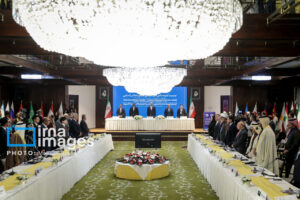
The Doha 2025 Forum started this morning in Doha, Qatar.
Avash News: The venue hosts the largest political and economic forum being held this year in West Asia.
Current and former prominent diplomats, as well as economic activists and global media representatives, are present at the event.
Among the main speakers are the president of Ghana, the head of the Syrian government, the prime minister and foreign minister of Qatar, the prime minister of Lebanon, the chief of the Kurdistan Region, the foreign minister of Turkey, the former U.S. secretary of state Hillary Clinton, and Bill Gates, the founder and former CEO of Microsoft.
Mohammad Javad Zarif, Iran’s former foreign minister, will also give a speech at the event. He will also participate in a number of panels.
The first panel of the forum was held with the participation of Sheikh Mohammed, Qatar’s prime minister; Kaja Kallas, the head of the European Union’s foreign policy; José Albares, the foreign minister of Spain; and Hakan Fidan, Turkey’s foreign minister, under the title “Mediation in a Time of Global Fragmentation.”
The Qatari prime minister said the nation’s prominence as a global mediator stems from its unique “geopolitical situation” as a small nation surrounded by larger nations.
“Our national security stands on the stability of the region,” he said. “As a small nation, we cannot become a superpower by military”, so Qatar’s “footprint” is created through diplomatic and investment outreach.
“That’s why we have always strived to settle conflicts through mediation. And in this fragmented world today, it’s more and more needed – the role of small countries,” he said.
Another panel on ways to achieve a truce in Ukraine was also held today with the participation of the deputy foreign minister of Poland, the parliamentary commissioner for human rights in Ukraine, and the head of the China Center for Globalization.
The third panel focused on Gaza and the reassessment of global responsibilities and ways to achieve peace.
The Qatari prime minister has said that achieving lasting peace between Israelis and Palestinians not only requires ending the bloodshed in Gaza, but addressing the “root causes” of the conflict.
“It is not only about Gaza. It’s about Gaza, it’s about the West Bank, it’s about the rights of the Palestinians for their state,” said Sheikh Mohammed.