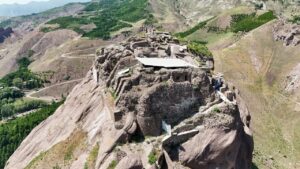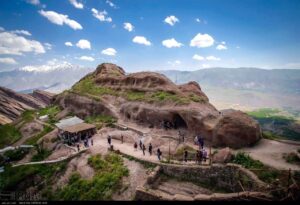
AVASH NEWS: Among tens of historical sites in Iran, a few names have been able to simultaneously occupy the attention of archaeologists, art historians, and collectors across the world. Ziwiyeh Hill is situated 55 kilometers to the southeast of Saqqez in Kurdistan, and it includes the remnants of a castle or the center of a ruling system which belongs to the first millennium BC.
The site’s global fame is linked to the accidental discovery of a large treasure hoard in the late 1940s; a collection including hundreds of gold, silver, ivory, bronze, and iron objects, many of which were brought into the market before the onset of scientific excavations and finally found their way into museums and private collections across the world.
Most of Ziwiyeh’s historical objects date back to the 7th century BC, which was nearly 2,700 years ago. This period coincided with the rule of the Mannaeans and the struggle for power between the Urartians and the Assyrians in northwestern Iran, which a few years later led to the emergence of the Medes. As a result, many researchers think Ziwiyeh is one of the most important links in the transfer of art from pre-Achaemenid civilizations to the magnificent art of the Achaemenid dynasty.
The most important relics of the treasure include medals and golden plaques, golden cups, carved ivories, decorative pieces of chariots, ceremonial weapons, and motifs of lions, ibexes, griffins, mystical creatures, and hunting scenes. These works are indications of Iranian artists’ and metalworkers’ expertise.
Today, works attributed to Ziwiyeh are kept in various museums, including the National Museum of Iran, the Louvre, the Metropolitan Museum of Art, and the British Museum, as well as in private collections around the world. This very scattering has made it difficult for researchers to restore the hoard completely and has caused disagreement regarding the origin of some of the works attributed to the treasure hoard.
Despite all the disagreements, researchers agree on one issue: Ziwiyeh is not merely a hoard of gold, but one of the most important pieces of evidence of Iran’s artistic and historical identity on the verge of the establishment of the first Iranian governments.
Ziwiyeh; a Treasure that Fascinated the World
It is not only because of Zendaya’s earrings that the name “Ziwiyeh” has become the talk of the town these days. The name is reminiscent of one of the most important and, at the same time, most controversial discoveries of the 20th century in the Middle East: a hoard that many think is a bridge between the art of the Assyrians, the Mannaeans, the Medes, and even the Achaemenids, and believe that the narrative of the establishment of ancient Iran will not be complete without knowing about it.
Ziwiyeh is the name of a historical hill near the city of Saqqez in Iran’s western Kurdestan Province; a site which has embraced the remnants of a castle or the center of a ruling system dating back to the first millennium BC. This region existed at a time when northwestern Iran was the meeting point of the great powers of the world, from the Assyrians to Urartu, to the Mannaeans, and then the Medes. The same geographic position turned Ziwiyeh into a crossroads for the exchange of art, ideas, and metalworking technology.
The global fame of the region is related to a sudden discovery. In the late 1940s, the local people encountered a big treasure of gold, silver, ivory, and bronze objects; relics that were traded among dealers and collectors instead of being given to archaeologists. Most of the pieces were taken out of the country and found their way into museums and private collections in Europe and the United States before being scientifically recorded.
The same happenings turned Ziwiyeh into one of the most complicated cases in archaeology. Unlike treasures that are discovered in scientific excavations and whose precise locations are recorded, much field information was lost forever. Therefore, researchers have to put the scattered pieces of the puzzle from museums, private collections, and old evidence together so that they can draw a more complete picture of the treasure.
Despite all these difficulties, the importance of Ziwiyeh has never gone unquestioned. The objects discovered at the site, from golden cups and plaques to carved ivory and ceremonial weapons, are one of the most complete examples of the art of metalworking from the first millennium BC. They are reflections of the worldview, political power, and religious beliefs of people who lived more than 2,700 years ago on this land.
Ziwiyeh is also important because of its effect on identifying the roots of Iranian art. Many researchers think that part of the visual language that later appears in the art of the Medes and then the magnificent art of the Achaemenids is rooted in the same artistic traditions of northwestern Iran. In other words, Ziwiyeh is not just a hoard of gold objects but a lost link in the chain of the evolution of ancient Iranian art.
Because of that, each piece which is reliably attributed to this hoard is not merely an expensive object or a piece of historical jewelry. Such a work is a document of Iran’s civilization; a document which cannot only be evaluated based on the price of gold or its scarcity, but also finds meaning through the information it gives scientists about the past. Maybe that is the reason why the release of images of Zendaya triggered reactions that went beyond the world of fashion. For many archaeologists, what was seen on the ears of this actor was not merely two pieces of gold, but two pages from the book of Iran’s history which, thousands of years after being made, once again drew the attention of the world toward Ziwiyeh and the unanswered questions that surround the fate of this hoard.
A Hoard of Treasure that Was Cut Apart
Maybe the biggest tragedy of Ziwiyeh was not its discovery but its fate after that discovery. In archaeology, the value of a treasure hoard is not only linked to the number of gold relics it includes. The real importance of a historical site lies in the fact that each object, along with other objects, completes part of a narrative; a narrative that can be about the structure of power, religious ceremonies, lifestyle, and even the political relations of a country.
However, this narrative about Ziwiyeh was shattered very soon. In the late 1940s, when a large portion of the hoard was accidentally discovered, scientific excavation had not yet begun. Before archaeologists had the opportunity to document the precise place where these relics were found, many pieces were taken out of the country by dealers and collectors. As a result, today we face hundreds of pieces of the hoard that are scattered across the world instead of one complete hoard.
Some of the relics of Ziwiyeh are kept in museums across the world, particularly in Europe and the United States. An important portion is still kept in the National Museum of Iran. Some of the relics that entered the art market later lacked a transparent provenance. Because of this, some specialists believe that not all relics known as Ziwiyeh objects today are really from Ziwiyeh, and some of them may belong to other archaeological sites in northwestern Iran.