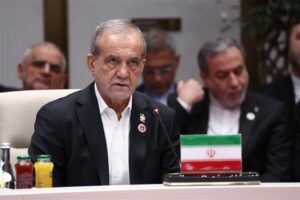
Speaking in a televised interview on Friday evening, President Pezeshkian said the understanding secured key commitments from the United States on sanctions relief, the release of Iranian funds and the resumption of investment, while ongoing talks are focused on establishing a framework for reopening the Strait of Hormuz. He also stressed that Iran would continue diplomatic engagement but would not remain bound by commitments if the other side failed to honor its obligations.
Islamabad Understanding and US Commitments
President Pezeshkian said the MoU reached by Iran’s Supreme National Security Council (SNSC) was the result of collective and expert decision-making. He noted that 12 of the council’s 13 members supported the understanding.
The president said nine provisions of the agreement constituted US commitments, while several others were joint commitments and one concerned Iran’s nuclear program and required further negotiations.
Strait of Hormuz and Ongoing Talks
President Pezeshkian said negotiations had initially produced tangible results, including progress toward lifting sanctions and releasing Iran’s frozen funds. He added that the parties had also discussed foreign investment in Iran of up to $300 billion and restoring normal passage through the Strait of Hormuz under Iran’s agreed framework.
He said the current negotiations had produced a roadmap for reopening the strategic waterway, which has been presented to Iran’s Leader Ayatollah Sayyid Mojtaba Hosseini Khamenei and approved.
According to the president, Oman initially raised some reservations but later agreed to the coordinated framework. Iran is now seeking guarantees that the United States will fulfill commitments concerning the lifting of sanctions and blockade, the release of Iranian oil and petrochemical revenues, resumption of investment and an end to military actions in Lebanon.
Diplomacy with Neighbors
President Pezeshkian stressed that Iran would continue dialogue while responding proportionately if the other side failed to honor its commitments.
He said reducing tensions, expanding relations with eastern countries and seeking sanctions relief would remain key foreign-policy priorities during the rest of his administration.
He also called for stronger ties with neighboring countries, particularly Muslim states, saying Iran seeks greater coordination with Pakistan, Afghanistan, Saudi Arabia, Turkey, the UAE, Qatar, Oman, Egypt, Azerbaijan, and Turkmenistan.
Regional Security and Israel
President Pezeshkian said regional countries should work together to establish security and stability and prevent the Israeli regime from easily attacking Islamic countries.
He emphasized that regional peace requires dialogue, mutual understanding and adherence to agreements.
Sanctions and Regional Economy
President Pezeshkian argued that reducing tensions and expanding regional and international economic relations were essential to improving Iran’s economic conditions and strengthening the country’s resilience.