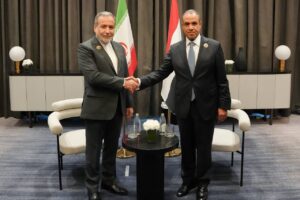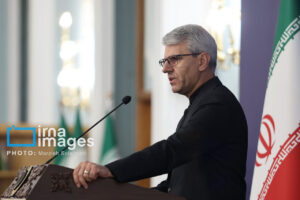
At his weekly press briefing on Monday, Baqaei said the Sunday visit by the Saudi deputy foreign minister took place “in continuation of a process that began two years ago,” adding that bilateral contacts have remained active as both sides work to build momentum in their restored ties.
“In this visit, we discussed both the bilateral relations between Iran and Saudi Arabia and the regional issues that are a shared concern of Iran, Saudi Arabia and other countries in the region, including the issue of occupied Palestine, Lebanon and Syria,” he said.
He stressed that Tehran and Riyadh are “determined to continue” their diplomatic path, which he described as a process aimed at “strengthening trust and understanding among regional countries” to advance common goals and enhance stability and security in West Asia.
Baqaei noted that Iran simultaneously hosted delegations from Turkey, Saudi Arabia and South Korea on Sunday, all of whom held talks with Iran’s foreign minister on bilateral relations and regional developments.
US ‘biggest threat’ to intl. security: Baqaei
Responding to a question about the hostile actions of the US president toward countries such as Venezuela and Washington’s continued support for the Israeli genocide in Gaza, Baqaei said, “The reality is that the United States, with the behavior it has shown during this period, has become the biggest threat to international peace and security.”
He added that US officials repeatedly issue threats “against Venezuela, Cuba, Nicaragua and even Brazil and Mexico” across the Western Hemisphere.
Iran FM’s visit to France
Asked by IRNA’s correspondent about the foreign minister’s recent phone call with High Representative of the European Union for Foreign Affairs and Security Policy Kaja Kallas following his meeting with his French counterpart in Paris, Baqaei said the trip to France was held at the French foreign minister’s invitation to discuss bilateral relations as well as regional and international developments.
“Naturally, in any conversation with European parties, the nuclear issue is also one of the topics of discussion,” he said.
Israel’s truce violations
The Foreign Ministry spokesperson also addressed questions regarding Iran’s assessment of the prospects for a ceasefire in Lebanon, offering a sharply critical view of Israel’s past behavior.
He said it is “well known” that Israel enters ceasefire agreements only “to violate them,” adding that experience has repeatedly confirmed this pattern.
Citing remarks from the UNIFIL spokesperson, Baqaei said the figure of “10,000 violations of the ceasefire from November of last year until today” is highly revealing.
“When a ceasefire is violated 10,000 times in such a relatively short period, it means that there is effectively no ceasefire, and the Israeli side is not faithful to any promise or commitment,” he said.
Australia’s designation of IRGC
Baqaei was also asked about Australia’s decision to designate the Islamic Revolution Guards Corps (IRGC) as a terrorist organization. He said Iran had already issued an official statement declaring its position.
“The matter is completely clear; Australia’s move certainly has no legal or factual basis,” he said, describing it as a continuation of an earlier action rooted in “a pretext or false information probably fed to them by the Zionist regime’s security services.”
He said the decision damaged decades-long diplomatic relations and downgraded bilateral ties.
He added that Australian officials, including police authorities in the region where Sydney is located, have “explicitly and officially announced” that Iran had no involvement in any incidents targeting Jewish sites in the past months, making Australia’s designation “a kind of payoff to the Zionist regime.”
US poses greatest challenge to non-proliferation
Responding to comments from a senior US Defense Department official warning that unilateral American actions risk collapsing the global non-proliferation regime, Baqaei said the statement reflected reality.
He argued that the United States itself poses the greatest challenge to preserving the non-proliferation system due to its “double-standard policies,” particularly its tolerance of Israel, which he described as being the main obstacle to establishing a nuclear-weapon-free West Asia.
He said Washington shields a regime that is “simultaneously committing genocide and aggression against other countries.”
Joint military drills in northwest Iran
On the “Sahand 2025” joint military exercise, Baqaei said the drills, held in northwestern Iran, aim to confront terrorism and involve five participating countries, with total involvement from “13 to 14 countries.”
He said the exercise demonstrates Iran’s commitment to coordinated, multilateral responses to terrorism, a threat that no country can tackle alone due to its transnational nature.
He expressed hope that such cooperation would expand to cover other areas, including transnational organized crime.
Venezuela developments
The spokesman also rejected claims raised in relation to political developments in Venezuela, including allegations regarding Iranian nationals or supposed offers of refuge to Venezuelan officials.
He called the question itself offensive to Venezuela’s people and government, arguing that no country has the right “based on bullying and coercion” to interfere in another nation’s sovereign decisions or dictate the fate of its officials.
Iran-China cooperation
On Iran-China rail connectivity, Baqaei said the route holds great importance for Iran, and that all countries involved share the goal of accelerating steps toward full operationalization.
He said Iranian officials in the Foreign Ministry and the Ministry of Roads are in regular contact with their Chinese counterparts.
“Good discussions have recently taken place,” he said, expressing hope that the process will be completed “in the shortest possible time.”
[This item is being updated.]