Avash News: The full text of the panel is as follows:
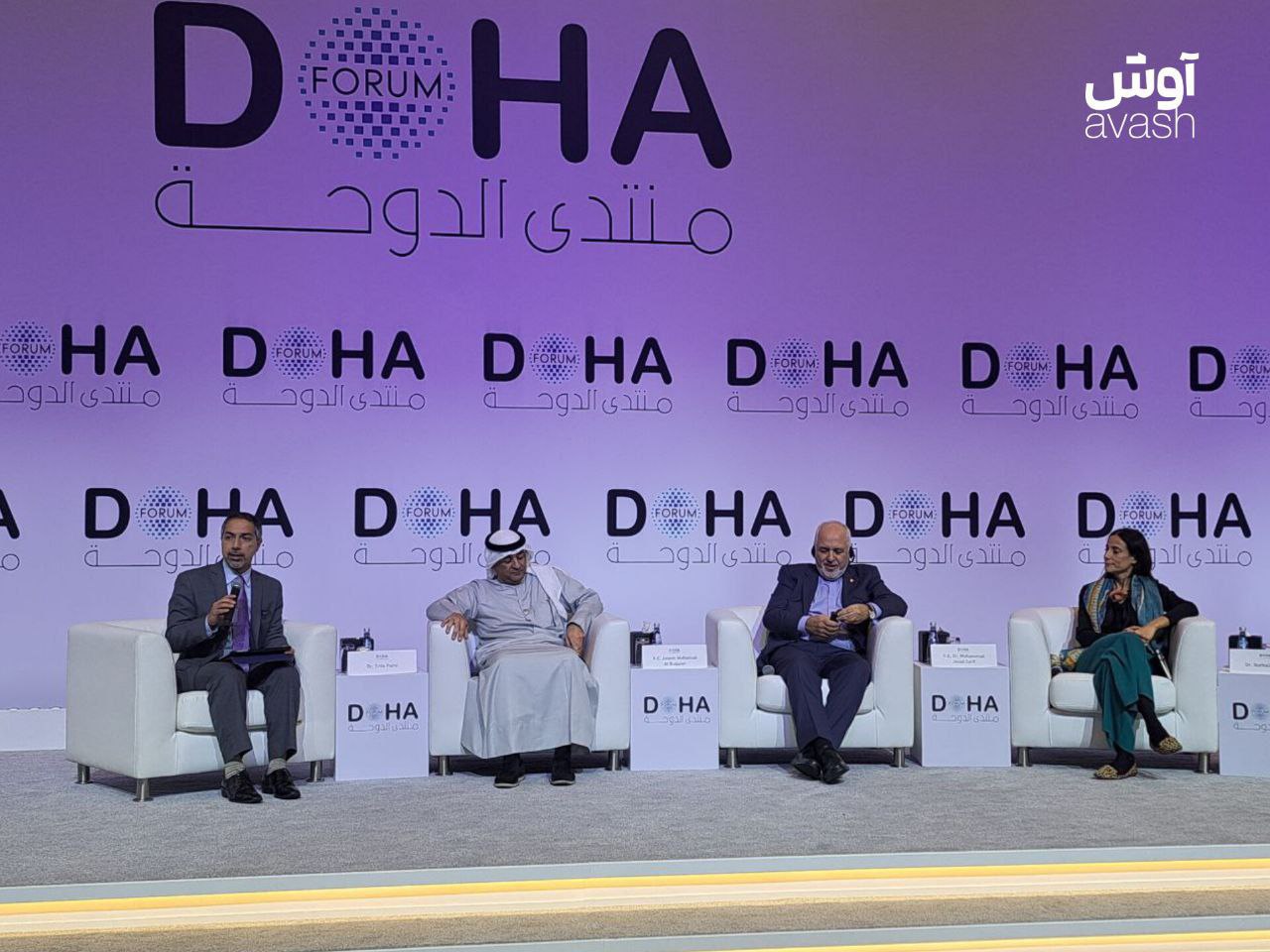
Welcome to panel “On Iran and Rechanging Regional Security Environment.” My name is Trita Parsi, the executive vice president of the Quincy Institute. We are delighted to have all of you here. And of course, and this Panel to discuss some of the very significant changes that have happened in the region, as well as Iran’s adjustment or perhaps lack of adjustment to some of these changes.
We have, as I mentioned, a great panel, and I want to introduce them to you right now. I start from my left to the right, which is Excellency Jasem Mohamed Al-Budaiwi, Secretary General of the Persian Gulf Cooperation Council.
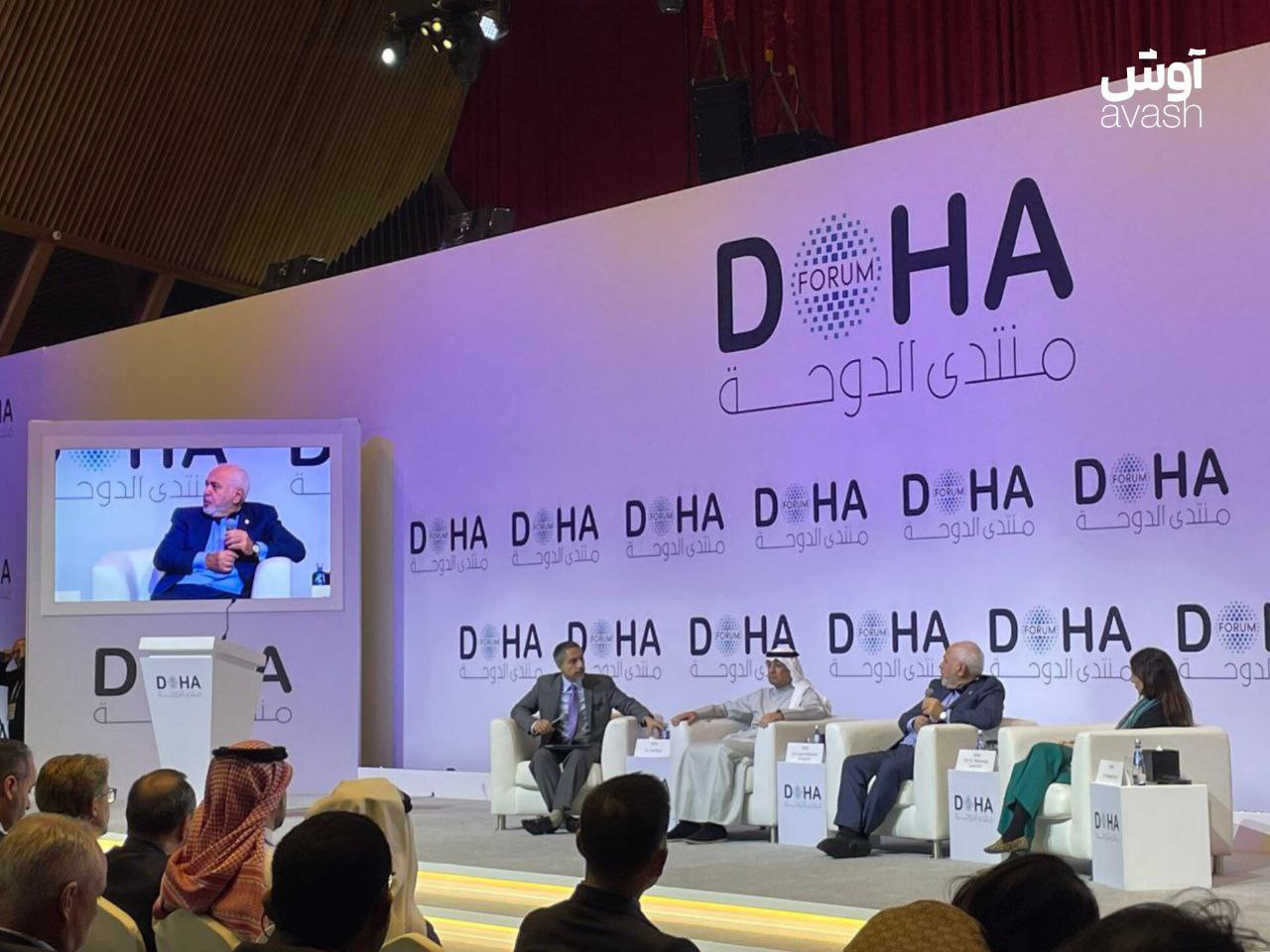
To his immediate left, we have his Excellency Dr. Mohammad-Javad Zarif. The Former Foreign Minister of Iran, as well as its Vice President for about a year, I think. And of course, the lead negotiator on the Iranian side for the 2015 nuclear agreement. He is currently an associate professor at Tehran University and the founder of the new Think Tank, and the President called “The Possibility Architects”.
And last but not least, Dr. Nathalie Tocchi, who is the director of the International Affairs Institute in Rome in Italy. She has served two high representatives of the EU, and in that capacity, she authored the European Global Strategy and worked on its implementation.
I’m gonna start right now. I’m gonna give an opportunity for questions from the audience as well, towards 10 or 15 minutes at the end. But given the importance of this topic, I’m just gonna cut to the chase right away. Dr. Zarif, Iran has suffered some very significant setbacks in the last two years. Many of its partner organizations are significantly diminished. Syria, that used to be an ally, is now more or less an enemy. And the region has changed dramatically, but it is not entirely clear whether Iran has adjusted to this new reality. From the outside, it is not clear whether Iran has a new strategy, whether it has a strategy, or whether it is simply paralyzed by these deep changes in the region. Dr. Zarif, is Iran suffering from paralysis right now?
Dr. Javad Zarif: It is good to be with you, and I am very happy to see all of you here. Let’s be realistic. We have had ups and downs in our region. There was a time when Iran was under attack by Saddam Hussein, and everybody was helping Saddam Hussein, and Iran was on the verge of collapse. I remember. Some of you may not be old enough to remember that, by I remember when Iraq invaded Iran, everybody expected us to go down the drain in 7 days. That is why the Security Council waited for 7 days before it issued its first resolution on Iran after it failed that wish, that we would just expired. It did not. Now, we have had our ups and certainly today is not one of our ups. But does it remain the same? I do not think so. Iran has gone through storms for almost 7 millennia. We have been invaded. We have been occupied. But we never went down the drain. We are still standing up. And we will continue to stand up. Two nuclear powers, let’s not forget, two nuclear powers, attacked Iran without any excuse, without any justification. They were hoping, as we all know, that by the Monday that Israel would attack our broadcasting as well as our National Security Council that we would be gone. Everybody expected that after the first few minutes of the war, where we lost our 17 highest military commanders, we would not be able to withstand. But Iran proved, I do not want to boast, because killing people is not a matter of boasting. But we proved that we could inflict serious harm on Israel. We proved that Iran is the only country in the region. Why are you talking about a weak country? Iran is the only country in the region when the United States wanted to attack us, it evacuated all of its bases in the region. That is not the sign of weakness. That is not humiliation. The United States, I mean, evacuated all its bases in the region, and I am absolutely sorry it was a base in Qatar that was attacked. I had hoped that it would be somewhere else. But be as it may, and I am happy that I am not in the government, so I can say whatever I want freely, but the fact of the matter is US had to evacuate all its bases. Take this; I think it has to be swallowed by everybody before they talk about a weak Iran.
Which other country in this region is going to be attacked by the United States and I know some of the countries in the region have been attacked by the United States, including a nuclear power! When did the United States have to evacuate its bases before attack? So Iran is strong. Iran has the capabilities, and capabilities are ingrained in Iran. They are not imported. We do not import our security. We do not purchase our security. We do not import our nuclear power. So we would put it on a platter like some of our friends in North Africa did and give it to the Americans. It is ours. So it is best for everybody to recognize this, to come to terms with it, and to start working with Iran. And I think if they come to terms with this, if they abandon this feeling that I obliterated the Iranian nuclear program. Calm down let’s walk together.
Trita Parsi: Is Iran, in your view, in your assessment, I think there would be many that would agree with you, not necessarily been weakened to that point. But my question is more, has Iran’s strategy shifted to the significant changes that have happened?
Dr. Zarif: No. Iran’s, you see, the problem with JCPOA, with the nuclear deal that I negotiated, was that that was a shift in Iran’s strategy, from resistance we went to compromise, and that’s why it faced so much opposition in Iran. You see, both Iran and the United States basically did something that they were not used to. We are used to resisting; the Americans are used to imposing. So we faced the greatest opposition in Iran, and the Americans faced the greatest opposition in the United States. Because they could not impose the nuclear deal, and we did resist any deal that was offered to us. We are backed to the resistance strategy which we are used to, we are very good at it. It may not be the best strategy that I would prescribe for Iran, but it is not the strategy that we are not very good at. We can resist; we have resisted. We only had two years of JCPOA, and that was an aberration, not the resistance.
One more thing that I think it would be important for all of us to consider is the fact that we can be prisoners of the past, or we can look to the future. Now we have a great opportunity. I was in the launch upstairs, and they were talking about problems in Syria, the problems in Palestine, and you know, nobody mentioned Iran. Every time we talked about Palestine, Iran was the obstacle. We talked about Syria. Iran was the obstacle. Now we’re talking about all of those places. Iran is not the obstacle. Now we see the obstacle as it was, and it will be, and that is the Israeli aggression.
We now know what we need to treat. That is the malady of our region and that malady needs to be treated. A regime that considers itself above the law, above international law, above humanitarian law. A regime that now goes on to publish maps. Have you seen the maps of the greater Israel? A regime that publishes maps that include countries in the region, entire Syria, entire Jordan, half of Iraq, and parts of Saudi Arabia. That was always the problem. But we managed to make ourselves a problem. so, thanks God we are no longer the problem. Look at the real problem.
Trita Parsi: On that point, Secretary General, the Foreign Minister of Oman, Badr al-Busraidi, recently stated at the Manama Dialogue two, three weeks ago, we have long known that Israel, not Iran, is the prime source of insecurity in the region. And he said, we have long known seems to suggest that this was not something that just came about because of the Israeli attack on Doha. And Turki al-Faisal of Saudi Arabia, otherwise known to be rather hawkish on Iran, repeated the same thing two days ago in Dubai, saying that it is definitely Israel that is a troublemaker and should be reined in by the U.S. At the same time, Washington has not shifted its perception. The NSS that was published yesterday by the Trump administration repeats the more than four-decade-long formulation in the U.S., which is that Iran is the chief destabilizing force of the region. Secretary General, was al-Busraidi’s statement something that only speaks for Oman? Does it speak for other countries in the PGCC? And if the latter, how is the PGCC then going to manage it, mindful of the fact that the U.S. seems to be so out of sync with the PGCC, while it nevertheless believes that its perception of Iran’s role is something that is still shared by regional states?
Secretary General of PGCC: Thank you for having me in this panel with these two great scholars. First of all, I would like reply to Aghaye Zarif by saying I assure you, and I assure the Iranian leadership and the Iranian people that nobody in the PGCC wants Iran to go down the drain. So you should name the people who want you to go down the drain, so everybody understands and comprehends exactly your point.
Second of all, you mentioned that the Iran-Iraq war and you pointed at the PGGC countries and this is a discussion that will take hours because there were also policies taken by Iran in 80s and I am a Kuwaiti and I have seen it and, I lived it and I have experienced it, but we do not want to go there because that is not the reason why we are here.
We are here to talk about the present and to talk about the future. How do we make our region as peaceful, as stable, as prosperous with our brothers and sisters in Iran? This is what we need to talk about. We need to put the foundation. We need to take the right steps towards trust-building measures, trust-building acts, in order to really enjoy what we have experienced as PGCC countries. We need to show Iran how we, in seven, eight decades, became the ninth economy in the world. The six PGCC countries, Mr. Zarif, GDP in 2024 is $2.4 trillion. Because of good governments, because of great management and great leadership, I’m sure Iran also has the same thing. This is what we would like to share with Iran.
But there are really serious measures that we would like our brothers in Iran to take. We need the idea of exporting the revolution, the good neighboring, the policies that Iran sometimes takes that really shakes the stability of the region. And I give you an example of the Huthis support. The UN Charter needs to be respected, the acts of dialogue and discussion and non-interference with the Shiites in the PGCC countries or in any other country.
We have put the right steps toward Iran. We have Saudi Arabia normalizing with Iran in 2023. We have our brothers in Oman taking the lead for trying to negotiate between you and the United States. And the PGCC countries called Mr. Araghchi last year in October, and we sat with him in Doha discussing ways to move forward in this relationship. And now there are even more discussions and ideas to have the second one, inshallah, very soon. So what the PGCC want from Iran are simple and basic, really very basic, like any normal neighborhood. This is what we would like to reach with Iran. Iran is our neighbor. We are their neighbor. They are history, they are culture, they are art, they are music. Iran is not what you only see on the TV. I’ve been to Iran when I was a young boy in 1978. I’ve seen Europe and Iran. So this is what we would like to share with you. We have so much to give Iran. We have so much to share with Iran. We need to take the right steps. We need Iran to be our number 3 partner. We need Iran to be moving forward. We, as you said, no need to talk about the history. It’s the present and the future that we should concentrate.
Trita Parsi: Thank you so much, Secretary General. Now I am shifting to you. If you, Nathalie, can bring in the European angle into all of this. EU-Iran relations have really deteriorated. Everything from, and we see that Europe used to be the actor that mediated between the United States and Iran, that has been replaced now by PGCC states. The Europeans for the first time perhaps, see Iran as a direct threat because of its support of Russia. The Iranians are very upset that Europe did not uphold the JCPOA from their perspective. And then, of course, you had the German chancellor praising Israel’s attack on Iran and calling it that Israel was doing Europe’s dirty work for it. And then, of course, the snapback decision in the last couple of months. What is Europe’s strategy vis-a-vis Iran at this point, beyond escalation?
Nathalie Tocchi: Ukraine is our first security priority
Dr. Nathalie Tocchi: Well, I mean, that would kind of require a two-word answer. …. But let me perhaps say a few things. Also, listening to what has been said up until now, what is it that we’ve learned, I think, over the last few months? We have learned that when diplomacy is unilateral, or bilateral, let’s say you can’t quite be trusted, right? I mean, there was a diplomatic process going on, and this did not prevent a war from taking place. So that’s one lesson that can be learned. The second, and I think we’ve been discussing this, is that indeed this has been, and I think we can see it also from outside the region, a shift in perception in terms of which is the revisionist player in the region, or which is the most revisionist player in the region. It used to be Iran in rightly or wrongly perceived to be as such.
Today, it is perceived as being Israel. And that, I think, is also a second fundamental shift. I think that inevitably, there is a lot of soul-searching in Iran itself. It had a deterrence strategy, which relied very heavily on the role of proxies, and that hasn’t turned out to be a spectacular success. And I think fundamentally, those two bits, on the one hand, Israel being perceived as the main revisionist player in the region, and on the other hand, inevitably, Iran having to at least reassess its own deterrence strategy is, I think, fundamentally what is bringing growing convergence between Iran and the PGCC. Now, we as Europeans, what is the problem here? So we were basically in the game in that very short period of time when things were going unlike how they normally go in the region. And it’s very clear that we’re no longer in that situation today. I think our problem as Europeans is that we have difficulty in holding two thoughts at the same time in our head. One thought, and it’s absolutely correct, is that Ukraine is our first security priority. This is existential for Europe.
And this is, I think, something that probably not just here in the region but elsewhere people perhaps don’t quite understand enough. So Ukraine is and will remain Europe’s first and most existential priority. Now that thought can be held in one’s head while at the same time thinking that we don’t necessarily need to view the rest of the world through the prism of the Russia-Ukrainian war. And I think this has been the fundamental mistake that we made in this region, both in terms of our relationship with Iran, but also the stance, for example, that we took in a subject which is not the subject of the conversation, i.e. the Gaza war, right? It is basically this dimensional perspective driven, as I said, by an existential interest which has at least put us at this point in time out of the game. So as to your question, no, today we don’t have a strategy.
Now looking ahead, what is it that one can say joining all these bits together? Well, if we do know that actually unilateral diplomacy has not actually led to anything, if we do see this growing convergence between Iran and the Persian Gulf, if Europe continues to have an interest in non-proliferation and in regional security, perhaps there is something that we could be doing to support that growing convergence, to basically put in place perhaps a different multilateral negotiation setup that could in time, whether it’s on the nuclear question or another regional question, but let us be very clear, we have always been as Europeans second players in the region, never first, right? And once upon a time the United States used to look at Europe as being its support in the Middle East. Now it doesn’t need Europe to play that role. Now it has the Persian Gulf countries to play that role directly. It doesn’t need Europeans. What therefore Europeans should be doing, rather than thinking through the prism of how is it that we can be useful to the United States in the Middle East, try and understand what is interests in the region are and approach countries in the region providing the support that may or may not be needed.
TP: So on the issue what is Europe’s interest. So much of the most important decisions Europe has made vis-à-vis Iran has been done, are decisions made by the E3, one of which is not even part of the EU any longer. And of course, with all of the things that have happened, there’s tensions, etc. For the sake of actually being able to have positive movement on the EU-Iran front, do you think Europe needs to move beyond the E3?
Dr. Nathalie Tocchi: I think in many aspects that E3 has run its course. I do think that, generally speaking, and not just as far as Iran is concerned, European foreign policy is effective only when it is driven by a contact group. So I think, you know, the trick is to have, on the one hand, something relatively small and relatively flexible while at the same time having a link to the broader EU, which was really the magic of the E3/ EU. But that particular format, I think, has run its course. So I think we should be thinking in terms of contact groups, but perhaps thinking about a slightly reconfigured – there are different European countries that are playing. You know, Spain, for example. I don’t want to talk about Italy. Spain, for example, has, I think, been playing a very interesting role in the Middle East over the last couple of years. So I think, you know, thinking a little bit outside the box, yes, contact groups, yes, a link to EU institutions, but perhaps not quite what was done in the past.
TP: Dr. Zarif, inside of Iran, you’re known as one of the individuals who have favored improving relations with the EU, with the U.S., who have oftentimes seen the EU as a bridge to some form of a resolution of the tensions with the United States. At this point, what do you see the role of the EU potentially being?
Zarif: Europe proved to be shooting itself in the foot in order to please the United States
Dr. Zarif: Unfortunately, and with all due respect, everybody in Iran has lost faith with Europe. Because Europe proved to be shooting itself in the foot in order to please the United States. Europe, I mean, the exercise of the so-called snapback, I say so-called because you search the entire JCPOA, the entire 2231, and you won’t find the word snapback, not because we didn’t think of it, but because if you look at the documents that are all reflected in my book, you see the word snapback, but we managed to remove it. It’s called the Dispute Resolution Mechanism, and Europe had no right, and it proved that it had no right. Even Josep Borrell, to withdraw the letter that it circulated on behalf of the EU on the dispute resolution mechanism, because Iran had invoked the dispute resolution mechanism on 2nd September 2016, that is while Obama was still in office. But Europe decided to follow American instructions to invoke Article 36 of the JCPOA. Rubio shouted at the Europeans, he yelled at the Europeans, for them to go ahead and basically disempower themselves and play any role in the Iran nuclear issue. The Europeans would have held the most important role because the U.S. was not part of the JCPOA, Europe was still part of the JCPOA, and Europe could have played a major role. So what did Europe gain by invoking 36? Absolutely nothing. And you read the national security strategy of the United States, which was published yesterday, it seems that based on that national security strategy, Europe is the greatest threat to democracy. That’s the benefit that our European friends got from basically shooting themselves in the foot to please Donald Trump. So my suggestion to Europe, and this wasn’t just the case with Trump, let me give you just one example to show you if I can. We signed an agreement with Airbus to purchase 118 Airbus airplanes in February 2016. Then we signed an agreement with Boeing to purchase 88 airplanes from Boeing in June 2016. In September 2016, when I threatened to invoke Article paragraph 36 of the JCPOA, the Americans, the Obama administration provided license. You know for how many airplanes? For 118 European Airbus planes, I placed the request in February, the Americans only approved 18. But of the 88 Boeing airplanes, I placed the request in June, the Americans approved 80. Even then, our European friends did not come to realize that the United States did not have their best of interests in mind. When we negotiated the JCPOA, anytime we came to the Americans doing something, they said, we have to go to Congress, we have to see whether Congress would agree. Anytime it can be put without the European presence. Anytime we came to the interest of the Europeans, the Americans said, Europe will lift this sanction, Europe will lift the other sanctions. So I think it is good for our European friends and for anybody else who believes that the United States will support their interests. To wake up and see, the United States will always support its own interests. And for the Israeli, their’s interest instead of its own interests.
Tocchi: United States actively acts against European interests
Dr. Nathalie Tocchi: Something, because I think, Dr. Zarif, you nailed it here. But this is why I come back to this Ukraine point. Obviously, the United States has always pursued its interests. Who doesn’t? Yeah, so that is, as you say, not new. What is new is a United States that actively acts against European interests. That is new. That is new. And that is, I think, what we are really struggling to swallow at the moment. Because, you know, we could see the argument, as I said, Ukraine is the first priority. I could see the argument. I mean, perhaps not the most ethical of arguments, but I could see the argument of saying, well, look, you know, the United States wants you to go ahead with snapback on Iran, but hey, they’re going to stand with you in Ukraine. I would say, well, look, at the end of the day, that’s a contract that works, yeah? What makes it so paradoxical is that what are we getting in return, as far as Ukraine is concerned? It is the national security strategy.
TP: Secretary General. Europe has faced this issue, the fact that the United States is reassessing its various alliance commitments, security obligations. We’ve seen that Israel has attacked Qatar with the justification that Hamas was present here, which I’m sure if you’re sitting in Oman, you’re wondering if Muscat is going to be hit if Oman engages in mediation with the Houthis, for instance, that also have a conflict with the Israelis. So I assume from the PGCC perspective, there is some reassessment of how it’s now going to structure its security, given the fact that Israel has emerged as a threat. The U.S. perhaps is not as reliable as it was before. In that context, how does the PGCC see Iran’s potential role as part of PGCC security?
SG: I think answering this question you have to start with steps and you cannot jump to security before you take certain measures, before you’re sure that the partner in front of you is a comfortable partner and you are a comfortable partner to them. And there are certain steps that we need to take together in order to reach that level of dialogue, a dialogue of engaged or integrated security. An example, the interference in Bahrain, we have not heard anything solid from Iran on it. The “Emirati islands”, we have a PGCC position, it’s not a UAE position, it’s a PGCC position, asking Iran, giving Iran two options, either direct dialogue between United Arab Emirates and Iran or the International Court of Justice. Iran has not answered us back with these two questions. We have the, at the same time, Iran wants us to engage in a dialogue with them in the Arash gas field that is shared between Kuwait and Saudi Arabia. So you want me to jump to security, my friend, and I have gaps before that, it’s almost impossible for me to take such steps. It’s trust-building measures, again. As for the PGCC thinking of reassessing their security, definitely the hit on Qatar by the occupying forces of Israel, is somehow a wake-up call for all PGCC countries, right after the attack, the leaders of the PGCC held an extraordinary summit, and then they called upon the ministers of defense. The summit and the minister of defense both were held here in Doha, and the minister of defense took certain measures, five points, to re-boost our security arrangement with each other, revisiting our exercises, looking at other options and engagement of security. So yes, definitely, we have taken certain measures in order to secure our areas and our countries.
TP: Thank you so much. I’m going to open up to the floor for any questions. I saw a hand go up right there. Go ahead, sir. There’s going to be a microphone coming your way very shortly.
Q- Thank you so much. I’m from Bulgaria, from New Bulgarian University. Dr. Zarif, I’ve covered US foreign policy for more than 20 years, and from what I saw, I think that since the turn of the 21st century, US presidents have tried everything to solve Middle East conundrums. They have tried armed invasions. They have tried diplomacy. They have tried humanitarian interventions. All have failed. And if we believe that Europe also failed to understand Iran, gets what’s right about Iran, wouldn’t Trump get something right about Iran? At least something.
Zarif: Let’s not open that Pandora’s box
Dr. Zarif: Well, Turkey is a part of the region, sometimes part of the problem, sometimes part of the solution. And we all need to consider ourselves people who are in this region and cannot leave this region. I mean, we didn’t choose our neighbors. We are here, we are stuck together, and we need to live together. Now, let me just make one point, and that is the point that the British ambassador made in the Security Council in 1971. And they said, let’s not open that Pandora’s box because Arab countries in the Persian Gulf will not be pleased with the outcome of opening what happened in 1967 to 1971. Nobody talks about their territory. Nobody goes to the International Court of Justice on their own territory. And we are affronted when people talk about our territory as if we owe them anything. Something happened in our region in the 1970s. Let’s not open that box because there are a lot of Iranians who believe that they were wronged when our 19th province was separated from Iran during the same deal that gave us our islands back. So, as I said, let’s not open that box.
If we want to talk about the past, the PGCC owes Iran about $100 billion that they paid to Saddam Hussein in order to bom us with chemical weapons. The PGCC paid Saddam Hussein $100 billion, but we are not coming to the doors of the PGCC every other day telling them to give us the money. Give us $100 billion, $1,000 billion of damages by Saddam Hussein, whom you supported, but when he attacked you, we came to your support. We came to the PGCC’s support. We came to you, to the Kuwaiti support, when Saddam Hussein attacked you and overnight took over your entire country. We did not start and say, they deserve it. He could have said that because he came to us first. He came to us and said, Why don’t we cooperate, because I’m going to control the entire southern Persian Gulf. Why don’t you cooperate with us? We said no. Although the Kuwaitis were your biggest supporters, although they allowed you to use Mubian to export your oil, although they brought the Americans to our region and they downed our airplane, but we will not allow you to take over Kuwait. We will support Kuwait. We will allow the Kuwaitis to come to our region. So, let’s stop talking about the past. Let’s talk about the future. President Rouhani came to Kuwait on the late Amir’s proposal with his preconditions, which I thought were impolite. And I told your foreign minister at that time he was impolite, but President Rouhani came and accepted those. You went to Manama, where the king of Bahrain said, Trump has assumed office. Let him deal with Iran, then we will deal with Iran from a position of strength. So, let’s not talk about that.
SG: This is a frank discussion between brothers. And this is how we talked in order to resolve our problems. We have a wonderful relationship with Iran, and we want to have a wonderful relationship with Iran.
Dr. Zarif: Let’s not talk about the past. We have three offers on the table. Hormuz Peace Endeavor. Menara (Middle East Network for Atomic Research and Advancement) and we have MAWADA (Muslim West Asia Dialogue Association).
Zarif: Minister Rabin decided to replace the enemy
SG: This is a frank discussion between brothers. And this is how we talked in order to resolve our problems. We have a wonderful relationship with Iran, and we want to have a wonderful relationship with Iran.
Dr. Zarif: Let’s not talk about the past. We have three offers on the table. Hormuz Peace Endeavor. Menara (Middle East Network for Atomic Research and Advancement) and we have MAWADA (Muslim West Asia Dialogue Association).
Q- Thank you so much for your insights. I have two very small questions with more focus on Iran. Two months ago, I was in the Mediterranean dialogues. They were trying to convince us that Iran is a threat in the region. So I want to ask you, is that the dominance or hegemony that Iranians have in the region that has made all these criticisms targeting Iran? My second question is that it is clear that Israel threatens the region, at least for us, the youth. I mean, I am Algerian. I want to know why Iran is always seen as a threat. Is it the strategy of your self-defense? Or is it you because you violated International laws?
Dr. Zarif: Well in 1991, and I want to quote Trita’s entry in the encyclopedia Iranica which he wrote with David Menashiri, an Israeli. And you know Dr. Trita Parsi is an expert on Israel-Iran relations. So in his entry in Encyclopedia Iranica, he says, with David Menashiri, an Israeli, and not a supporter of Iran. In 1990, Israel decided to start the talks with the Arabs, the Madrid Talks and the Oslo Talks, Prime Minister Rabin decided to replace the enemy, in order to convince the Israeli population that it needed to talk to the Arabs, and that enemy was Iran.
Zarif: Why do we have to be blamed for problems that are caused by Israel?
So, Israel started the securitization of Iran. First inside Israel, in the first half of the 90s. then internationally. Netanyahu went to the US Congress in 1997 and stated before the US Congress in 1997 that Iran was 3 years away from a nuclear bomb, and before the turn of the century, they would have a nuclear bomb. That was the securitization in the international community. Then, in order to subvert the resistance in the region, the United States came to the region, Secretary Clinton, I think. No, it was Condoleezza Rice, creating the coalition of the moderates in the region, portraying Iran as the enemy instead of the Israelis. Now, Iran, as they say our friends in Hezbollah, are involved in their own insecurity, Hamas, Islamic Jihad, have their own trouble, why is it, as you say, the problem in the region persists? Is Gaza genocide our fault? Or the fact that after many decades now Israel comes up with the plan for “Greater Middle East” . Is not a time for our Arab friends to wake up and smell the coffee? We want to work with the Arabs. We have paid the heavy price. I tell you, not a single shot has been fired in the past 45 years, by any of our so-called proxies in order to advance our interest.
They have been fighting for their own interest and we have been paying. Iran has paid and we are resentful to our Arab friends because we supported Arab cause more than the Arabs did. And we get to be blamed. We supported Palestine more than any Arab country supported Palestine. You know I and under two American designation. Why? Why am I under two American designation? Personally! Did I kill anybody? No. just because Netanyahu wanted me be under two American designations. So, which Arabs is under American designation because of Netanyahu’s request? Tell me. Why do we have to be blamed for problems that are caused by Israel? Our friends in the region have everything to gain through cooperation with Iran. We have no desire. We are the biggest country in the region. We have no territorial ambitions against our friends in the region. They are talking about our territory. We are not talking about their territory. We do not have territorial ambitions against our friends in the region. We do not want have access to the high seas as Saddam Hussain wanted. Every PGCCC country has territorial disputes with each other. Now my friend is talking about Arash oil field which is disputed between Iran and Saudi Arabia and Kuwait and he says this is Kuwaiti-Saudi business! Why is it a Kuwaiti-Saudi business? Because you say so?
TP: Secretary General you have only 1 minute go ahead….
SG: Seriously, what Israel is doing in the region is extremely ridiculous. What Israel has been doing since October of 2023 is something that we, the Arab countries, the biggest supporter for Palestine, unlike what my friend here says, we have been explaining it to the international community, and they did not realize until maybe 50,000 Palestinians died, then the international community woke up and saw what Israel has been doing with the Palestinian people and to the stability of the region. This is what we have been saying. This is what we are saying. It is an international crisis, not a regional crisis. Maybe so, when President Trump interferes seriously, there is a hope for reaching stability and a continued ceasefire there. But without this Security Council being active, being really active, we will not reach what we can reach with the Palestinian people.
TP: All right. Thank you so much. Unfortunately, we are out of time.

Doha 2025 Forum begins, Zarif to deliver speech
The Doha 2025 Forum started this morning in Doha, Qatar.
Avash News: The venue hosts the largest political and economic forum being held this year in West Asia.
Current and former prominent diplomats, as well as economic activists and global media representatives, are present at the event.
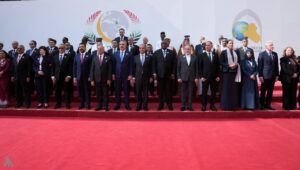
Among the main speakers are the president of Ghana, the head of the Syrian government, the prime minister and foreign minister of Qatar, the prime minister of Lebanon, the chief of the Kurdistan Region, the foreign minister of Turkey, the former U.S. secretary of state Hillary Clinton, and Bill Gates, the founder and former CEO of Microsoft.
Mohammad Javad Zarif, Iran’s former foreign minister, will also give a speech at the event. He will also participate in a number of panels.
The first panel of the forum was held with the participation of Sheikh Mohammed, Qatar’s prime minister; Kaja Kallas, the head of the European Union’s foreign policy; José Albares, the foreign minister of Spain; and Hakan Fidan, Turkey’s foreign minister, under the title “Mediation in a Time of Global Fragmentation.”
The Qatari prime minister said the nation’s prominence as a global mediator stems from its unique “geopolitical situation” as a small nation surrounded by larger nations.
“Our national security stands on the stability of the region,” he said. “As a small nation, we cannot become a superpower by military”, so Qatar’s “footprint” is created through diplomatic and investment outreach.
“That’s why we have always strived to settle conflicts through mediation. And in this fragmented world today, it’s more and more needed – the role of small countries,” he said.
Another panel on ways to achieve a truce in Ukraine was also held today with the participation of the deputy foreign minister of Poland, the parliamentary commissioner for human rights in Ukraine, and the head of the China Center for Globalization.
The third panel focused on Gaza and the reassessment of global responsibilities and ways to achieve peace.
The Qatari prime minister has said that achieving lasting peace between Israelis and Palestinians not only requires ending the bloodshed in Gaza, but addressing the “root causes” of the conflict.
“It is not only about Gaza. It’s about Gaza, it’s about the West Bank, it’s about the rights of the Palestinians for their state,” said Sheikh Mohammed.