Avash New: As Iran’s twenty-seventh intangible heritage inscription, this recognition further strengthens the country’s position among the world’s top ten cultural heritage powers. With 29 tangible and natural heritage sites and 27 intangible heritage elements, Iran now stands as one of the foremost guardians of the world’s historical and cultural memory.
Iranian mirrorwork—an art deeply rooted in the architectural traditions of Iran—is a reflection of the nation’s aesthetic sensibilities, sacred geometry, and light-centered worldview. In this exceptional craft, tiny mirror pieces are cut and arranged with miniature-like precision across surfaces such as ceilings, domes, walls, columns, and niches. By refracting light across thousands of shimmering facets, a spiritual, dynamic, and majestic atmosphere is created. The Hall of Mirrors in Golestan Palace (Tehran) and parts of Sheikh Lotfollah Mosque (Isfahan) are among the most iconic historical manifestations of this art on a global scale—masterworks that embody the Iranian interpretation of light, order, proportion, and spiritual elevation in architectural form.
The process of mirrorwork integrates a complex set of skills including design, drafting, mirror-cutting, plaster carving, plastering, painting, and mosaic techniques. This delicate and demanding craft requires years of master-level experience, geometric precision, and a deep understanding of the proportions characteristic of Iranian architecture. Mirror pieces are cut into diamond-like forms of various shapes and sizes and are then fixed onto the surfaces using natural, eco-friendly adhesives such as sarish (traditional paste). Motifs drawn from Iranian geometry, floral patterns, arabesques, birds, and both embossed and flat designs enrich this art with identity and depth.
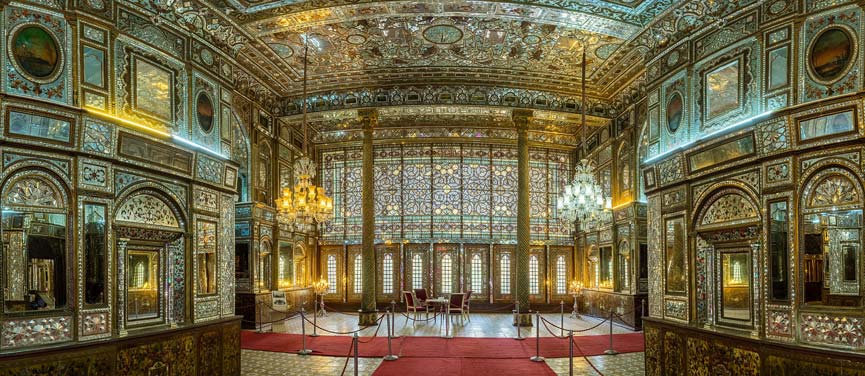
In Iranian culture, the mirror has long symbolized purity, illumination, honesty, and the revelation of truth—a concept that, within architecture, elevates mirrorwork from a decorative technique to a semiotic language. The reflection of light in the small mirror pieces not only generates unparalleled visual effects but also contributes practically to illuminating interiors and optimizing energy consumption. This dual function positions mirrorwork as one of the inherently sustainable and ingenious arts of traditional architecture.
The nomination file for “the skill of mirrorwork in Iranian architecture” was prepared with the broad participation of master artisans, restorers, architects, universities, professional associations, and local communities from Tehran, Isfahan, Mashhad, Shiraz, and Qom. After technical and field assessments, UNESCO identified the living continuity of the craft, its active intergenerational transmission, its wide range of applications, and its cultural and social significance as the key criteria qualifying it for inscription.
The global registration of “the skill of mirrorwork in Iranian architecture” is not only a tribute to one of the most authentic arts of Iranian architecture, but also a strategic opportunity to enhance cultural diplomacy, expand artistic tourism, strengthen national identity, and present Iran’s civilizational capacities on the world stage. This inscription brings Iran a step closer to solidifying its position as one of the principal centers of creativity, meaning, and craftsmanship—a position rooted in a heritage that is firmly anchored in tradition while illuminating the horizon of global cultural development.