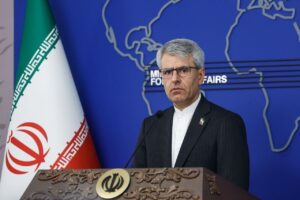
Speaking at a weekly press conference, Baqaei said on Monday that over the past week, the United States and the Israeli regime have continued their destabilizing actions in the region. Meanwhile, Iran’s diplomatic apparatus, maintaining a serious and responsible approach, has pursued efforts to safeguard national interests and regional stability.
These include high-level contacts between Iran’s president and heads of various states, frequent discussions between the foreign minister and regional counterparts, and recent visits to Turkey and Russia, reflecting Tehran’s continuous engagement in protecting its national and regional priorities, he added.
Review Underway on Talks Resumption
Iran has repeatedly experienced US breaches of commitments, deception, and unfulfilled promises over the past decade, with the most serious instance occurring in June, he said, adding that the hard‑won experiences will be factored into all future decisions.
There are clear contradictions in Washington’s rhetoric and behavior, and threats are incompatible with genuine diplomacy and that US actions in the region amount to persistent violations of fundamental principles of international law, he said, noting that Iran has already demonstrated its seriousness and goodwill in diplomacy, while shortcomings lie with the other side.
Interest in talks
When asked about alleged links between the US president’s renewed interest in talks, Baqaei said such claims remain for the media to discuss. However, evidence indicates the Israeli regime has repeatedly exploited similar scandals to influence policymakers in Western capitals.
Diplomacy and National Interests
Baqaei stressed Iran’s commitment to diplomacy for defending its national interests and safeguarding regional stability. He cited recent high-level communications between Iran’s president and regional leaders, and visits to Turkey and Russia, as part of broad efforts to strengthen peaceful engagement.
Response to EU’s unlawful move
Baqaei said all European ambassadors in Tehran were summoned following the EU’s illegal and misguided move against the Islamic Revolution Guards Corps (IRGC). He confirmed additional retaliatory measures are being reviewed, describing the EU’s decision as a strategic miscalculation meant to please the US and the Israeli regime.
Condemnation of Israeli Crimes
He denounced the Israeli regime’s intensified attacks on Lebanon and Gaza, calling them blatant violations of international law and ceasefire guarantees. He urged the United Nations and its Secretary‑General Antonio Guterres to assume direct responsibility for preventing the regime’s continued impunity.
Sanctions relief priority for Iran
Baqaei said claims that talks have shifted from sanctions relief to merely preventing war are incorrect. The spokesperson stressed sanctions removal remains Iran’s non‑negotiable priority, tied directly to nuclear confidence‑building and ending unjust economic pressure on the Iranian people.
Risks of adventurism against Iran
The spokesperson said regional states understand that any threat against Iran would spread instability across the region. He noted ongoing close contacts with Saudi Arabia and warned against media manipulation and third‑party attempts to exploit regional sensitivities.
No change in Iran’s drills
He also rejected reports of canceled joint or domestic military drills, saying no changes have occurred. Annual naval exercises with China and Russia will continue as planned, while IRGC drills are proceeding normally to maintain readiness and defensive capabilities.
IRGC ensures regional security
Baqaei dismissed hostile labeling by foreign forces, stressing the IRGC is a formal part of Iran’s armed forces. He said it conducts professional, routine drills and plays a central role in maintaining security and stability in the Persian Gulf and Hormuz Strait.
Israel behind fragmentation of Islamic nations
The spokesperson said the Israeli regime’s actions show a clear agenda of division and domination, citing occupations, attacks on regional countries, and Gaza’s destruction. He warned that appeasement of Israeli violations will eventually affect Europe and beyond, not just the Islamic world.
IAEA must fulfill responsibilities
He said the IAEA director general’s lack of information on Iran’s nuclear facilities stems from Israeli attacks on nuclear sites, not Iranian non‑cooperation. The spokesman urged the agency to acknowledge aggression, resume suspended duties, and avoid politicization driven by Western misuse of the Joint Comprehensive Plan of Action (JCPOA) mechanisms.
Attempts to damage Iran–Turkey ties
The spokesperson said Iran‑Turkey relations remain strong and respectful, despite hostile media reports. He praised Ankara’s recent role in easing regional tensions and warned that some actors seek to undermine regional cooperation, expressing confidence in Turkey’s prudent handling of such narratives.
Time key factor in potential talks
He further said Iran is reviewing diplomatic options carefully while noting time is crucial. The spokesperson said past talks were sometimes abused, stressing that each day sanctions are lifted or reduced matters, and decisions will reflect both urgency and lessons from previous negotiations.
US sanctions prevent trade
The spokesperson said the absence of Iran‑US economic relations results solely from Washington’s self‑imposed sanctions, not Iran’s policies. He noted US law prohibits economic interaction, making sanctions the true barrier to cooperation, including in energy sectors.
Strategic ties with China, Russia
He said Iran maintains strong strategic partnerships with China and Russia, both UN Security Council members. The spokesperson stressed their responsibility to oppose unlawful use of force, noting ongoing consultations and recent statements by both countries rejecting US coercive actions.
Rejecting ultimatums or deadlines
Baqaei said Iran has never accepted ultimatums in diplomacy and denied receiving any US deadline. He also rejected reports about seized oil shipments linked to Iran, saying relevant details must be addressed by the Oil Ministry and claims lack a factual basis.
[This news item is being updated.]