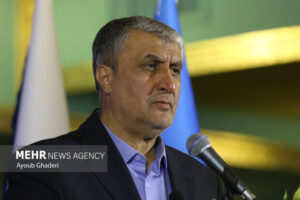
Avash News: Mohammad Eslami, head of Iran’s Atomic Energy Organization, in an exclusive interview with Avash, referring to the IAEA Director General’s politicization and the file that has been built against Iran, stated: “Due to the political nature of our nuclear file and external pressures on the Director General, not only can we not hope for its closure, but these pressures may also increase daily.”
He spoke about the possibility of Iran’s file being referred to the UN Security Council at the IAEA Board of Governors’ March session and emphasized that Western countries and the U.S. will not miss any opportunity to exert pressure on Iran.
Eslami also noted that Iran’s 60% enriched uranium in recent months could have been a factor in preventing the snapback mechanism and the reinstatement of previous resolutions, adding: “Of course, today no resolution exists, and from Iran’s perspective, as well as that of many other countries, these resolutions are now history.”
The head of the Atomic Energy Organization once again stressed that Iran has no intention of pursuing nuclear weapons, stating: “Iran is capable of defending itself without nuclear arms and already possesses the necessary deterrence.”
Eslami further spoke about Russia’s strong cooperation in constructing new units at the Bushehr nuclear plant and announced that fuel for the 2026 operation of Bushehr has already been secured.
Western Powers Do Not Want Iran’s File Closed
Avash: Mr. Eslami, what is the latest status of Iran’s relations with the International Atomic Energy Agency? It seems the Director General continues to insist on political positions, and relations are unlikely to calm down?
Eslami: The key is to look at the nature of this file. Essentially, it is a political issue and a lever of pressure. Based on 25 years of experience and existing evidence, this file is political, and from the Western perspective, it is never meant to be closed. Over the years, various Iranian governments negotiated on this political issue, leading to the JCPOA, but the U.S. and three European countries did not adhere to the agreement. Ultimately, the snapback mechanism ended it all. So, this is a political file, and there are many signs of that.
Avash: After the bombing of nuclear facilities, was a new inspection protocol introduced? Have there been meetings between Mr. Kamalvandi, the AEOI’s Deputy for International, Legal, and Parliamentary Affairs, and the IAEA’s safeguards deputy in Tehran and Vienna?
Eslami: The 12-day war was unprecedented in history. We have never had a bombing against nuclear facilities, as military attacks on such sites are prohibited. All these sites were registered with and closely monitored by the IAEA, and there was never any violation of legal safeguards. Yet, a psychological war is being waged to create excuses and political pressure against our country. We are NPT members and implement safeguards, though according to Iranian law, cooperation with the IAEA was suspended for the security of nuclear facilities and personnel. When the Director General does not condemn attacks and ignores our reports and letters while applying pressure like hostile countries, it shows part of the pressure is being managed. Nevertheless, inspections of undamaged sites continue according to IAEA safeguards.
Avash: What about the damaged sites?
Eslami: Damaged sites must have safeguards procedures defining what to do in case of attack. The IAEA has neither provided such definitions nor shown readiness to do so. Article 68 of the safeguards refers to natural events, but in case of bombing or military threats, the situation is different. Daily, we face active threats, including open threats from Israeli and U.S. officials. Security conditions remain akin to wartime, and it is natural to follow defined procedures.
Avash: Has any reconstruction or debris removal been done in the past six months?
Eslami: Our security conditions follow the regulations we pursue. Our priority has been to ensure the IAEA behaves professionally, acts independently according to its statute, and defines procedures if sites are attacked. The IAEA is obliged to do so. In September, at the 2025 IAEA conference in Vienna, we proposed a plan to prohibit military attacks on nuclear facilities, which could have been adopted globally, but under U.S., European, and Israeli pressure, the agency blocked it. Naturally, we act according to domestic law and national security.
The essence of our nuclear industry is knowledge and technology, not physical infrastructure.
Some say bombing Iran’s enrichment sites reduces U.S. interest in the nuclear issue. But the U.S. strategy document prioritizes advanced sciences and technologies, including the nuclear industry, AI, and quantum. While these are allowed for the U.S., Iran’s nuclear program—critical for national needs—is restricted. Bombing is physical, but the essence is nuclear knowledge and technology, which we control.
Avash: Is there a chance Iran’s file will be referred to the UN Security Council?
Eslami: At the March Board of Governors meeting, I expect the West to use the opportunity to increase pressure. Referral is likely, though secondary—it is a lever of pressure. The U.S., having exited 65 international organizations, believes these institutions do not serve its interests. In such a world, every country must safeguard its interests using its power.
Avash: Iran offered to remove or dilute 60% enriched uranium to prevent snapback. Is this option still on the table?
Eslami: Producing 60% uranium is for future national needs, such as nuclear propulsion. Previously, this measure was considered to prevent snapback and UNSC resolutions under Resolution 2231. Legally, after October 18, 2018, those six resolutions no longer exist.
Avash: Do we need nuclear weapons?
Eslami: Nuclear weapons are not part of Iran’s military doctrine, and the Supreme Leader has issued a fatwa on this. Strategically, Iran does not need nuclear arms to defend itself and possesses sufficient deterrence.
Avash: What is the status of Bushehr units 2 and 3, and Russia’s cooperation?
Eslami: Russia’s cooperation is excellent. Unit 2 and 3 construction has progressed well. Workforce has increased from 200 to 6,000, with potential to reach 12,000. Domestic factories produce required components. Fuel for 2026 has been secured. Financial and logistical challenges existed but are now resolved.