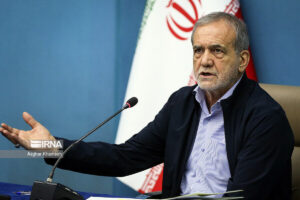
In an exclusive interview with Avash News, Mohammad Eslami referred to the politicization by the Director General of the International Atomic Energy Agency (IAEA) and said that due to the political nature of Iran’s nuclear case and external pressures on the agency, not only is there no hope for Iran’s nuclear case to be closed, but these pressures may also increase every day.
He said that Iran’s nuclear case could probably be referred to the UN Security Council in March, adding that Westerners and the United States would not miss the opportunity to use this to exert more pressure on Iran.
Eslami said that 60 percent enriched uranium could be a factor in not implementing the snapback mechanism and the return of past resolutions, adding that, of course, today there is no resolution, and based on Iran’s view and that of many countries, these resolutions are a matter of history.
The head of the IAEO said that Iran’s nuclear program has not deviated toward building a nuclear bomb and said that Iran is able to defend itself even without nuclear weapons and has sufficient deterrence.
Eslami said that inspections of damaged nuclear sites have been carried out in accordance with the agency’s safeguards. He said that Iran is still in a state of war and under active threat.
Eslami noted that Iran’s nuclear file could be submitted to the United Nations Security Council. He added that the exchange of 60 percent enriched uranium was aimed at preventing the snapback mechanism.
Avash News: What is the latest situation regarding Iran and the IAEA? It seems that the Director General of the IAEA still insists on his political position, and these relations are not going to reach a point of ease.
Eslami: Iran’s nuclear program is a political movement and a leverage for pressure. Based on the past 25 years of experience and the existing evidence, this case is political, and according to the Westerners’ view, it is not going to be solved. Years of negotiations have been carried out, and different governments in the Islamic Republic have negotiated over this political program, with the result being the JCPOA. However, the United States and the three European countries did not adhere to the agreement. Finally, the snapback ended everything. Therefore, it is a political case, and there are many signs of this.
Avash News: It was supposed that a new protocol would be written for inspections after the bombing of Iran’s nuclear sites. Has any action been taken in this regard?
Eslami: The 12-day war happened for the first time in Iran’s history. Prior to that, our nuclear facilities had never been bombed, as military attacks against nuclear facilities are forbidden. All these sites are registered with the IAEA and have been closely monitored by it, and none of these bombed sites has ever deviated from regulations; therefore, psychological warfare is underway, producing pressure and accusations against our country by using this issue as a tool. We are a member of the Non-Proliferation Treaty (NPT) and implement the safeguards. Of course, cooperation with the agency has been suspended to save the lives of nuclear industry workers and ensure the safety of nuclear facilities, upon the approval of Iran’s parliament. When the Director-General of the agency does not condemn the attacks and does not pay attention to our letters and reports, and, on the contrary, like adversary countries, puts pressure on us, it means that he is managing part of the pressure. However, inspections have been carried out at sites that have not sustained damage.
Avash News: How about the damaged sites?
Eslami: The damaged sites must have a definition under the safeguards system so that we know what to do when they are attacked. The agency has not offered such a definition and has not shown any readiness to indicate that it will do so in the future. What is mentioned in Article 68 of the safeguards concerns natural incidents. However, the situation is different when these sites are bombed and a military and security condition is underway, and there is still a high probability that such conditions may continue. We have always faced active threats, such that covert and overt sources, as well as Israeli and American officials, have publicly threatened us. We are under active threats and are still in a war-like condition with regard to security matters. Therefore, it is natural that we have defined procedures and approvals for such conditions and act based on them.
Avash News: Some say that after attacks on Iran’s uranium enrichment sites and halt in their operation, the nuclear issue is no longer attractive for the Americans and they pursue non-nuclear issues. Is it really right that the appealing of such subjects have really been faded for them and Iran’s nuclear industry has reached a point which is no more negotiable?
Eslami: If you see the United States National Security Strategic Document, you will notice that their top priorities are science, technologies and developed industries. The United States’s president has mentioned three topics including the development of IA, the expansion of nuclear industry and Quantum. Therefore, if these three issues are related to three technologies that make nations superior, how they could be legitimate for the US and forbidden for Iran, which its nuclear industry is needed in the country. This dual standard and the rule of jungle which govern the world have distorted the international law system.
Avash News: I meant that if our nuclear capability is still enough so that the Americans want to encounter it as a negotiating issue?
Eslami: Bombing facilities has physical nature but the main part of the work is nuclear technology and knowledge that is endogenous and is managed based on our determination.
Avash News: The next March meeting of the IAEA Board of Governors will be held. What are your predictions?
Some believe that Rafael Grossi’s remarks have paved the way for reporting Iran’s program to the UN Security Council.
Eslami: They presented anti-Iran resolutions at previous meetings of the Board of Governors and intensified pressure on our country. They also try to disturb Iran’s domestic peace, which is a clear manifestation of their animosity. They will naturally take advantage of the Board of Governors’ meeting. I predict they will also use this opportunity to exert further pressure on Iran.
Avash News: So, is there a high probability that Iran’s case will be reported to the Security Council?
Eslami: Yes, it is likely. Of course, whether it is reported or not is a secondary issue, because it is a leverage for pressure. Why did the U.S. withdraw from 65 international bodies? The President of the United States has said that these bodies are not working to meet U.S. interests; therefore, we withdraw. This means these bodies have been established to meet the interests of the United States. Trump has explicitly stated in the National Security Strategy document that former U.S. presidents pursued the country’s interests through these bodies, but these organizations were not successful, so we now meet our needs through military and economic power. Such an approach deals a blow to the UN Charter, which was meant to safeguard the interests of all countries through a legal framework. In such a world, it seems natural for any country to safeguard its interests through its own power components.
[This piece is being updated…]