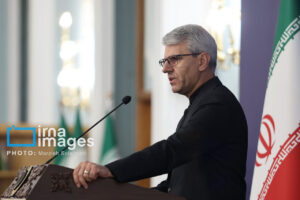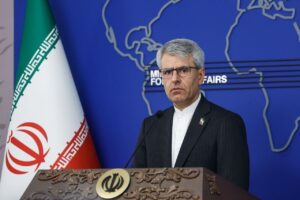
Iran’s Foreign Ministry spokesperson Esmail Baqaei has stressed that the country independently makes decisions on international agreements based on its national interests, saying the final decision on the Convention on the Legal Status of the Caspian Sea rests with the Iranian Parliament.
Speaking at a weekly press conference in Tehran on Monday, Baqaei said the convention, signed in August 2018, had been under inspection for years by the Ministry of Foreign Affairs and other relevant institutions before being submitted to parliament.
Responding to questions about criticism over the timing of the convention’s referral, he rejected the claims that the move was linked to the recent war or pressure from another country.
Iran independently makes decisions regarding its national interests, Baqaei said, adding that the country’s position on international instruments is determined solely by its interests and considerations.
He noted that the convention has five signatories — the five Caspian Sea littoral states — and cannot enter into force until all five countries have joined it. He said it was natural for the other four countries to favor its early entry into force.
Baqaei emphasized that the Foreign Ministry had fulfilled its responsibilities and would continue explaining the agreement and considering different views, but ultimately, under Iran’s Constitution, parliament is responsible for determining its fate.
Regional security
Addressing a question about the emerging defense understanding among Pakistan, Saudi Arabia, and Turkey, Baqaei said recent regional developments reflected a growing realization that security cannot be purchased from outside powers.
He said Iran has consistently advocated regional cooperation, mutual trust and indigenous security arrangements without dependence on external actors.
Baqaei argued that developments in recent years, including the Gaza war and the Israeli regime’s acts of aggression in Lebanon and elsewhere, had strengthened the perception among regional countries that the regime poses a major threat to regional stability.
He also criticized US support for the Israeli regime, saying Washington had contributed to regional insecurity. Iran, he added, believes security in the region is indivisible and that arrangements based on regional realities and a comprehensive understanding of threats could help prevent instability.
Iran raises concerns over Kuwait
Baqaei also criticized Kuwait over its refusal to provide consular access to four Iranian nationals detained in the country.
He said Iran had repeatedly requested access, describing it as a legitimate right under international law, and called on Kuwait to reconsider its position and facilitate the release of the Iranian citizens.
He also criticized Kuwait’s reported closure of the only Iranian school in the country, calling the measure strange and unjustifiable. He said the school had operated for decades without problems and suggested the decision appeared to be politically motivated.
ICC faces criticism
Regarding Chad and Venezuela’s reported moves to leave the International Criminal Court (ICC), Baqaei said such decisions reflected growing international disappointment with selective justice.
He argued that pressure from the United States and its allies had undermined the court’s ability to pursue war crimes and genocide in the occupied Palestinian territories.
According to Baqaei, the failure to ensure accountability for serious international crimes could represent a major setback for decades of efforts to strengthen international justice.
Iran, Oman talks
Baqaei also said that Iran and Oman are continuing negotiations on a mechanism for safe navigation through the Strait of Hormuz, with the two sides yet to finalize a joint statement on the issue.
Baqaei responded to a question about whether Iran and Oman had discussed imposing transit fees on ships using a proposed new route through the strategic waterway, and whether such fees would be shared between the two countries, saying such details were not currently under discussion.
“We are not discussing such details at this stage. The discussions are still continuing,” he said, adding that the two sides had already reached an understanding on the navigation route.
“Regarding the joint statement, there are still some technical points that are being discussed, but the negotiations are proceeding very smoothly and constructively,” the spokesman said.
Baqaei said the arrangements under discussion would include mechanisms to monitor the safe passage of vessels through the Strait of Hormuz, as well as cooperation on environmental issues, maritime services and combating crime.
“Obviously, when you provide maritime services, you should also receive compensation for them,” he said.
Asked about the outcome of Iran-Oman talks and Iran’s conditions for reopening the Strait of Hormuz, Baqaei rejected the notion that the waterway had been closed because of a disagreement between the two countries.
“The Strait of Hormuz was not closed because of a difference of opinion between Iran and Oman!” he said.
He attributed the closure to the US-Israeli military aggression against Iran, the exploitation of the strait, and the use of military bases located along the southern shores of the Persian Gulf to attack Iran.
“Therefore, it is natural that determining the shipping route between Iran and Oman is a bilateral matter between the two countries,” Baqaei said.
He acknowledged that the arrangement would have implications for international shipping involving other countries, but stressed that the negotiations themselves were between the two coastal states and had the specific objective of reaching an agreement on a safe route for ships through the Strait of Hormuz.
Baqaei said reopening the strait would depend on the removal of conditions imposed on Iran and the region as a result of the US-Israeli military aggression.
“Keep in mind that we are still in a state of war,” he said, arguing that continued US maritime blockade prevented the Strait of Hormuz from being considered a secure waterway.
He referred to UN General Assembly Resolution 3314, which defines aggression, saying that “a maritime blockade of this kind constitutes an act of aggression” under the resolution.
“As long as the US maritime blockade continues, and as long as other US violations continue, the conditions necessary for us to say that the Strait of Hormuz has become a secure waterway will not exist,” the spokesman said.
He said Washington must stop and make amends for its “illegal and destructive actions” before further steps could be discussed.
No final decision on Pezeshkian’s trip to New York
Baqaei also addressed whether President Masoud Pezeshkian would travel to New York to attend the upcoming UN General Assembly session. He said no final decision had yet been made and that the issue would be discussed closer to the annual gathering.
“Every year, as you know, the delegation of the Islamic Republic of Iran usually participates in the General Assembly session at the level of the president,” he said, describing the event as the UN’s most important annual gathering.
Iran, he added, intended to use this year’s session to present its positions, although the final decision would depend on circumstances and developments. Further information would be provided in the coming weeks.
When you wrestle with pigs, you cannot expect not to get dirty
Asked about his language in a recent response to US President Donald Trump, Baqaei said Iran makes use of its rich literary, cultural and civilizational heritage when confronting its adversaries.
He cited George Bernard Shaw, saying, when you wrestle with pigs, you cannot expect not to get dirty.
Sometimes, getting muddy is part of the wrestling that has been imposed on you, Baqaei added.
Tehran expects Iraq to prevent any misuse of its territory against Iran’s security
Baqaei said Tehran expects Iraq to prevent any misuse of its territory against Iran’s security, adding that the two countries must work to ensure a clear outlook for bilateral ties, including in the security field.
Baqaei said that both sides are aware of threats to their shared borders.
He stressed that Iranian officials have consistently received assurances from the Iraqi government and the Kurdistan Region that they will make every effort to prevent terrorist groups and extra regional actors, including the United States, from using Iraqi territory to harm Iran.
Baqaei described the cooperation between Iran and Iraq as positive, expressing hope that it will continue to expand on the basis of the security memorandum signed several years ago.
Pakistan sent invitations for visits by Iran’s Parliament Speaker and FM
Baqaei noted that invitations for visits by Foreign Minister Seyyed Abbas Araghchi and Parliament Speaker Mohammad-Bagher Ghalibaf have been received, adding that the trips will take place when the time is appropriate.
Mentioning recent trips made by Iran’s Minister of Industry, Mining, and Trade Mohammad Atabak and Minister of Interior Eskandar Momeni to Pakistan for discussions related to their portfolios, he emphasized that the focus is primarily on bilateral relations, describing Iran–Pakistan ties as highly important and added that they have become even more significant over the past few months for various reasons.
Regular exchanges are a natural part of the strong relationship between the two neighbors, he said.
Baqaei dismisses Netanyahu’s claim on Iran’s nuclear program as fabrication
Baqaei rejected Israeli Prime Minister Benjamin Netanyahu’s claim about the nature of Iran’s nuclear program as an outright fabrication, calling the allegation of an Iranian atomic bomb a lie that has been propagated for three decades.
In response to a question during his weekly press conference on Monday regarding Netanyahu’s claim that IRGC Commander Ahmad Vahidi had stated that as long as Israel and the United States possess nuclear weapons, Iran would continue working on them, Baqaei described it as a clear case of lie fabrication — production to consumption in less than six hours.
This is a fake piece of news generated from a Twitter account in India; a few hours later, it appeared on Israeli television networks; the Zionist prime minister issued a statement based on it; and within five or six hours, they turned a lie into a so-called fact, he added.
This single episode is a handful from the whole sack of all the Zionist regime’s claims against the Islamic Republic of Iran — including the imaginary nuclear bomb, the official said, adding that this has been built on precisely the same pattern: a lie that they have force fed the international community for thirty years, and which has become the very basis for the Zionist regime’s aggression against Iran.
Iran rejects Ukraine’s claim that attack on Iranian ship was unintentional
Regarding the attack on the commercial vessel and referring to the Ukrainian president’s admission about the intentional nature of the attack, as well as recent statements by Zelensky regarding a security memorandum with the Zionist regime and weapons purchases, he said Iran is not convinced by the Ukrainian claim that this action was unintentional.
If Ukraine does not compensate for its aggression against the Iranian ship, we will do it ourselves, he stated.
Iranians are skilled chess players
Reacting to the US president’s claim that back-channel negotiations with Iran continue and his comparison of the talks to a chess game, he said whether overt or covert, Iranians are well-known chess players.
Iran gives no credibility to reports on US military capability
Commenting on the reports of declining US missile stockpiles and whether it alters US calculations for continuing attacks, and does Iran view this as a sign of erosion in US military capability, Baqaei said that Iran gives no credibility to any report, positive or negative, about the US’ capability.