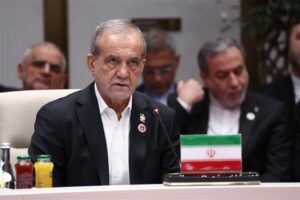
Addressing the 26th SCO Summit, President Pezeshkian highlighted major security and economic challenges facing the region and stressed the need for greater cooperation among member states to consolidate stability and build a shared future.
He said trust-building, respect for national sovereignty, non-interference in internal affairs and intergovernmental cooperation were essential to achieving sustainable security, drawing on the SCO’s more than two decades of experience.
President Pezeshkian identified terrorism, violent extremism, drug trafficking, transnational organized crime and cybercrime, along with growing geopolitical rivalries, unilateral policies and the use of military force, as major threats to regional stability and emerging economies.
Referring to recent developments in West Asia and US and Israeli attacks against Iran, he described such actions as violations of the fundamental principles of the UN Charter and international law. He also outlined the course of the conflict and developments afterward, reaffirming Iran’s position regarding its commitments under the Islamabad memorandum of understanding.
The Iranian president emphasized that security and development were interconnected and inseparable, urging the SCO to address economic and security dimensions simultaneously.
He identified intra-SCO trade, customs facilitation, transport corridors, connectivity between ports and logistics centers, expanded transit capacity, and stronger supply-chain resilience as key areas for economic cooperation.
President Pezeshkian proposed three economic initiatives: establishing a bank to deepen financial and banking cooperation, creating an export and investment insurance union, and forming an energy consortium.
In the security field, he also proposed establishing a strategic security studies center within the organization to identify emerging threats and contribute to regional stability.