Avash News: That woman was buried with special rites and respect. Two symbolic objects: a weight stone and a sword were buried next to her body – a combination reminiscent of the “Goddess of Justice.”
Chagasfel was discovered in the 1970s in Behbahan, Khuzestan Province in southern Iran by a team led by Hans Neisen of the University of Chicago’s Oriental Studies Department.
The area has since been considered an important civilization site in the Persian Gulf. Archaeological findings indicate that the area dates back to the early 5th millennium BC.
After a long hiatus, Iranian archaeologists returned to Chagasafli in 2015. During this time, they discovered more than 5,000 graves. Ten brick graves were among them. Apart from individual graves, some of them were mass graves. In one of these graves alone, 52 skeletons were found, and in another, 120 human skeletons.
Abbas Moghadam, an archaeologist who supervised the excavations at the historical tomb of Chagasafli, said: “In addition to pit graves that include individual graves, mass graves made of stone and brick were also identified, and according to evidence, some of the skeletons have been re-placed in the graves and some of them have remained in their original form.”
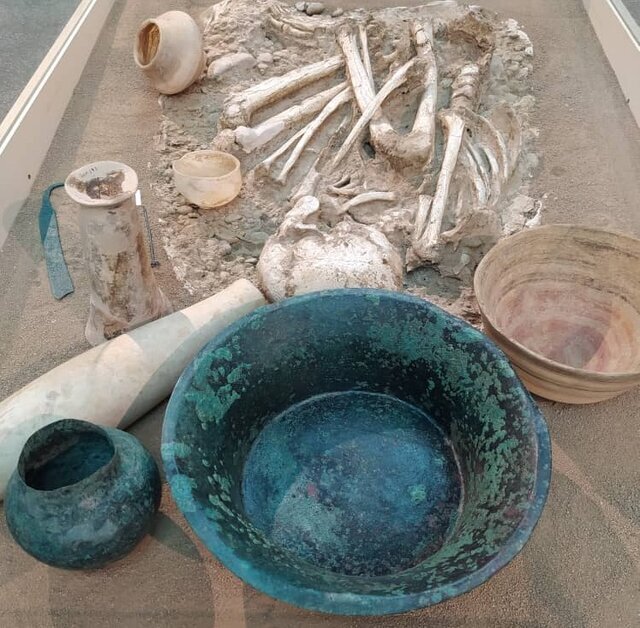
Archaeologists discovered the 6,000-year-old skeleton of Khatoun in the same individual graves next to mass graves containing 52 bodies. The woman, estimated to be 25 years old, was buried in fetal form. Khatoun is the name Abbas Moghadam gave to the skeleton.
A large copper basin, a copper jug, a hairpin, two marble bowls, two earthenware cups, a large sword, a dagger, and a large number of knitting needles were buried with her. A stone weight was placed near her forehead.
According to Moghadam, these objects were placed next to the bodies of the dead so that they could be used after death.
According to Moghadam, Khatoun’s skeleton and the combination of objects buried with her are reminiscent of her image of the “goddess of justice” holding a sword and scales.
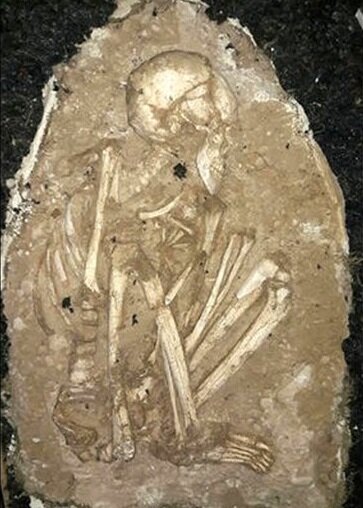
The archaeologists’ interpretation of this tomb was that she was actually a woman of high authority who played the role of judge in her community and was responsible for enforcing the law and regulations in her community.
Khatoun was not the only woman discovered in the historical tomb of Chagasafli. According to Moghadam, the predominance of women’s roles in their societies was one of the striking aspects of the social patterns of that historical period.
Archeologists have identified 102 burial objects, half of which belonged to women. Evidence suggests that women played dominant and decisive roles in their societies.
The tomb of Chagasafli still holds untold secrets, but excavations have been halted for now. Moghadam says Chagasafli has been invaded several times, first by British and American oil companies. After land reforms and land grants to farmers, houses were gradually built in this historic area.
Moghadam said that now large and small villages have occupied the area, and a gas pipeline has passed through the area, putting the area at risk of destruction.