Conservation specialist Manijeh Hadian Dehkordi explained that Pomodoro is renowned worldwide for his polished bronze works, often partially split open to reveal intricate inner structures. Iran holds three examples of this sphere: the largest at the Museum of Time, another at the Tehran Museum of Contemporary Art, and a miniature at Niavaran Palace, along with a separate column sculpture. Large-scale spheres of this type exist in only a few prestigious locations, including the UN headquarters in New York, UNESCO in Paris, and St. Peter’s Square in Vatican City.
Current restoration measures include photogrammetry, microscopic analysis, and damage mapping by a team of metal conservation experts. The treatment will involve careful cleaning, corrosion removal, and surface stabilization with protective resins. Following consultation with the Pomodoro Foundation, the aim is to restore the sculpture’s original polished finish rather than retain a patina.
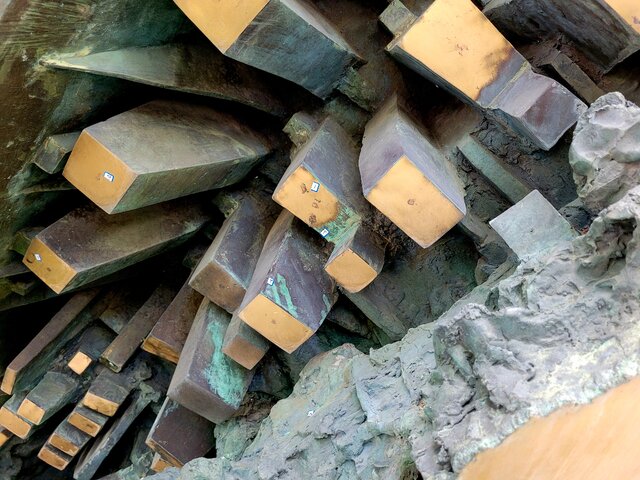
Shiba Khadir, metal restoration specialist, noted that materials recommended by the Pomodoro Foundation are being sourced locally or internationally. Mechanical cleaning will be minimized to avoid scratches, and chemical methods will be tested to prevent any color change. The restored sphere will remain outdoors, making ongoing monitoring and maintenance essential.
Created in 1974 and brought to Iran in 1978, Sphere Pomodoro is recognized as a first-tier contemporary art heritage piece, with notable examples also displayed at Trinity College Dublin and the Vatican Museums.