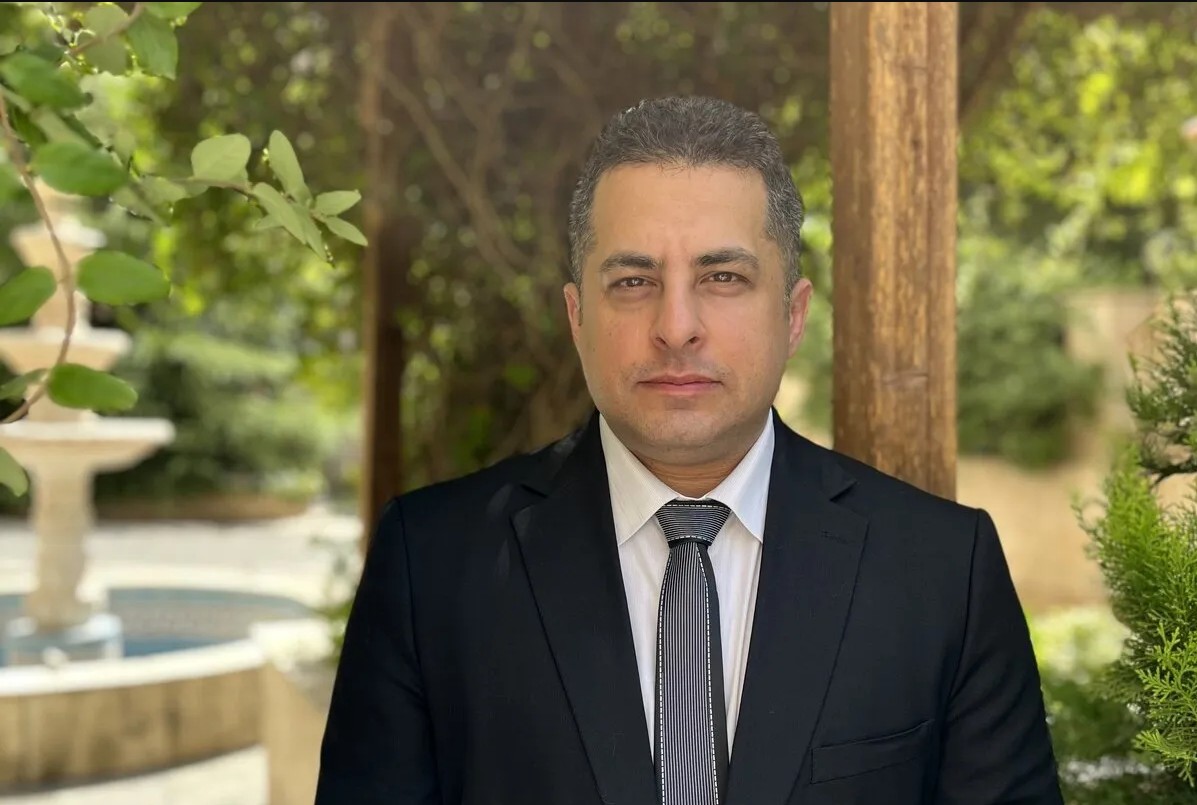
AVASH News: Lamerd was struck by the United States on the first day of the 40-day war with a new type of weapon. The attack resulted in the deaths of civilians, including young athletes who were at a gym at the time.
The full text of Nasri’s post:
Today, I stood in Lamerd.
I had read the reports. I had studied the forensic reconstructions by Airwars, The New York Times, BBC Verify, the painstaking work on trajectory angles, fragmentation patterns and blast radii. None of it prepared me for standing beneath these walls, or meeting the people who live behind them.
Lamerd is a small city of about 30,000 people in Fars province. It is the kind of place where a stranger is offered food before anyone asks his name. I have rarely encountered a community so instinctively and openly hospitable. People who had only recently buried their children still insisted on pouring us tea.
That warmth, in the face of what was done to them, is the first thing the world should know about Lamerd. The second is what these walls tell you, if you take the time to look.
On February 28, 2026, the opening day of the US-Israeli war on Iran, the United States fired Precision Strike Missiles into this city. Independent forensic reconstruction has identified at least three. Eye witnesses say there were four.
The PrSM is not an ordinary missile. It does not simply strike a point on the ground. It detonates in the air, roughly fifteen to twenty metres above the surface, turning the area beneath it into a killing zone. The blast sends tens of thousands of white-hot tungsten fragments in every direction, ripping through walls, cars and human bodies.
Investigators counted more than 2,000 individual fragment impacts along a single 150-metre stretch of one residential street. I walked that street today.
I did not need the number. I could see it.
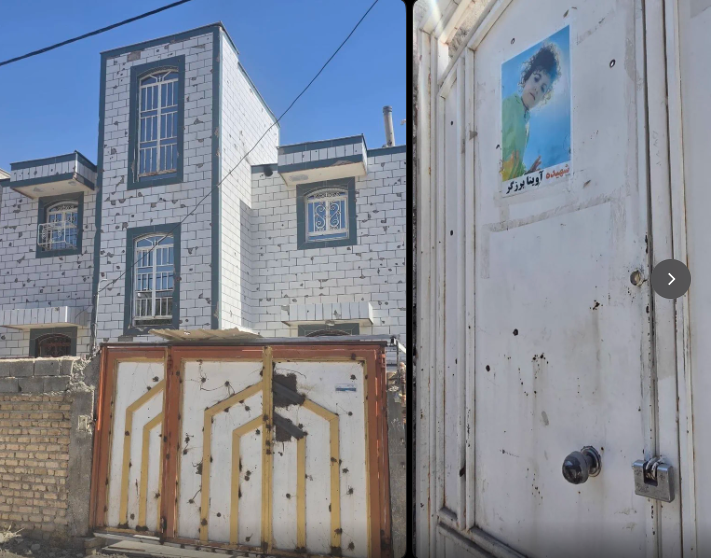
Look at the photographs. The facades are not simply damaged. They are pocked from roofline to foundation, in a pattern no accident could produce. The asphalt of the schoolyard is covered with hundreds of small grey scars where fragments struck the pavement.
Then there is the steel door. The kind of door you would find on any modest home. It has been punched through in a dozen places. Taped above the holes is a photograph of a curly-haired toddler.
Her name was Avina Barzegar.
She was two years old.
She was killed in her family’s backyard.
This is how the attack was described to us by people who lived through it.
A missile struck first, directly above the Shahid Naimi sports hall, where a girls’ volleyball team was training. Panic followed. People did what people instinctively do when something explodes nearby: they ran outside, toward the open air, believing that was where they might be safe.
That was when the second missile came down.
Then a third.
Then a fourth.
Each detonated over a different part of the same small city: a school, a residential area, places where people had run because they thought the street was safer than the building they had been inside.
At least 21 civilians were killed that day, including children as young as two. More than 170 were wounded. Spinal injuries. Amputations. Catastrophic burns.
We met the family of a seventeen-year-old girl who lost both eyes.
We met the family of another young girl who will spend the rest of her life in a wheelchair, her spine severed by fragments that fell from a clear afternoon sky.
I heard about a little girl who no longer speaks. The trauma and bleeding in her brain took her voice, along with so much of what childhood was supposed to give her.
None of these girls carried a rifle. None wore a uniform.
Among those killed and maimed in Lamerd, there was not a single member of an armed force, Iranian or otherwise.
According to the forensic reconstruction, the missiles were launched from mobile batteries in a Persian Gulf Arab state that hosts American forces, a state that would later condemn Iran when Iran exercised its inherent right of self-defense.
And what was Washington’s response?
It was not that Lamerd contained a military target. No such target has ever been identified by CENTCOM.
Instead, the story changed.
First, a CENTCOM spokesman flatly said that no American strike had taken place within thirty miles of Lamerd that day. Then footage emerged that could no longer be dismissed. The explanation changed. The missile seen in the footage, they said, was actually an Iranian Hoveyzeh cruise missile.
Weapons analysts at Janes and McKenzie Intelligence, along with the visual-forensics teams at The New York Times and BBC Verify, examined the same footage independently. They reached the same conclusion. The silhouette, the mid-air detonation and the fragmentation pattern all pointed to one weapon used in that theater.
It was not Iranian.
None of this should surprise anyone who has followed this war closely.
The PrSM had never been used in combat before February 28. Lamerd was its combat debut. A live-fire demonstration in a civilian city, whose geography apparently made it a convenient proving ground.
And by the Pentagon’s own measure, the test was a success.
Within a month, Lockheed Martin had reached a new agreement with the Department of War to quadruple PrSM production, later reported by independent investigators to be worth some $8.4 billion.
Days after the missile killed Avina Barzegar, CENTCOM commander Adm. Brad Cooper publicly celebrated its combat debut, calling it “an unrivaled deep strike capability.”
Tell that to the toddler on the door.
Iranian civil society will not allow what happened in Lamerd to disappear the way so much of Iraq and Afghanistan disappeared from public memory.
Those societies had their bar associations, universities and forensic institutions hollowed out by decades of dictatorship, invasion and war before anyone expected them to build a serious case file.
Iran does not face those same constraints. It has tens of thousands of practicing lawyers, a functioning forensic medicine system, land and hospital registries, dozens of law faculties, and a diaspora that includes lawyers admitted to practice in jurisdictions that recognize universal jurisdiction.
We will use every one of them.
We will pursue Donald Trump, Marco Rubio, Pete Hegseth, Adm. Brad Cooper, and every officer who executed their orders, in every forum on this earth that will hear us, for as long as it takes.
This is not only Iran’s fight.
People anywhere, including in the United States and Europe, can do something about it.
1- Pursue universal jurisdiction. If you live in a country that recognizes universal jurisdiction over grave breaches of the Geneva Conventions, press prosecutors to open a file. Many of these governments speak constantly about the independence of their judiciaries. This is where that claim gets tested.
The legal basis exists. The precedents exist.
2- Demand an end to the contracts: Demand that your government, and any government with a Lockheed Martin contract, cancel it. Every state party to the Geneva Conventions has obligations to “ensure respect” for international humanitarian law. Those obligations do not disappear because a weapons contract is profitable.
A company should not be able to field-test a weapon on a residential street and then collect billions of dollars to manufacture more of it.
3- Say their names. Be loud. Organize. Say Avina Barzegar’s name. Say the names of the other children killed on that street. Keep saying them until they cannot be forgotten. Let Lamerd become the case that finally forces the world to confront this weapon and ban its use against civilians, so that no city anywhere becomes someone else’s proving ground again.
And do not accept, for one second, the claim that this is “still under investigation.”
This is a government that has told the American public that it can read an Iranian officer’s name tag from a satellite in orbit.
It closed the Lamerd file within days, through denial, without answering the questions raised by BBC Verify, The New York Times or Airwars.
An administration with that level of claimed surveillance capability does not need more time to determine who fired four missiles into a city of 30,000 people.
It has known since the morning of February 28.
It has decided that the truth is inconvenient.
Avina Barzegar was two years old.
That is why we do not stop.