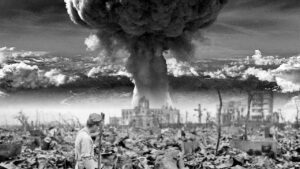
As the fighting dragged on and Tehran refused to yield on his terms, the threats turned apocalyptic. Trump warned that “a whole civilization will die tonight, never to be brought back again.” He promised to level every Iranian bridge and power plant, pledging to plunge ninety million people into darkness in what legal experts warned would be a war crime. The rhetoric grew extreme enough to raise the specter of a nuclear strike.
This is not an aberration peculiar to Iran. It is a method, and Iran has felt its sharpest edge. Others have encountered milder versions of the same approach.
Washington has floated absorbing Canada as a fifty-first state, to be achieved, in Trump’s own words, through “economic force.” It has pressed Denmark to hand over Greenland, refusing to rule out military action while imposing tariffs that began at ten percent, with a path to twenty-five. It has talked of retaking the Panama Canal by force if necessary. Even routine trade partners have been treated as adversaries. South Korea, praised one week as a “model ally,” was threatened with higher tariffs the next because its legislature had not ratified a deal quickly enough. The European Union was warned of thirty-percent tariffs. As for Venezuela, its president was kidnapped in a military raid and flown to New York, after which Trump declared the United States would “run” the country and collect its “sanctioned oil.” Even Oman, a longtime ally and a mediator in the Iran talks, was warned that if it “gets in the way,” Washington would bomb it. Countries with no stake in the underlying disputes have faced secondary sanctions for trading with states Washington seeks to isolate.
In all these cases, the same tactic emerges. A demand is issued. Pressure follows, bombs at the extreme, tariffs and sanctions in less severe cases. The purpose is not to resolve a dispute through bargaining, but to make resistance too costly. The other side is invited to “negotiate” after its ability to refuse has been weakened.
The deeper danger lies in what this does to sovereignty. The equality of states is a foundation of peaceful international relations: a country’s borders, resources, and right to govern itself are not bargaining chips to be surrendered under duress. When a great power treats another country’s territory as something that can be purchased and its consent as an obstacle to be pressured away, it does more than seek an advantage. It advances a world in which sovereignty belongs to those strong enough to defend it.
None of this is new, and history has recorded where it leads. In the 1930s, Adolf Hitler advanced not by opening with war but by issuing demands, one territory at a time, each presented as the last: the Rhineland, then Austria, then the Sudetenland, handed to him at Munich in 1938 by governments sure that a concession would buy peace.
The parallel is not just in the man, but in the method: coercion in place of agreement, contempt for any law that would restrain the strong, and the threat of destroying a people as a move in a negotiation.
The tactic depends on isolating each target until resistance appears futile and accommodation seems the safer choice. The answer is solidarity grounded in international law.
Appeasement does not buy lasting safety from a bully. It lowers the cost of the next demand. Solidarity can raise it. States that value their sovereignty should stop bargaining for it one by one and start defending it together.