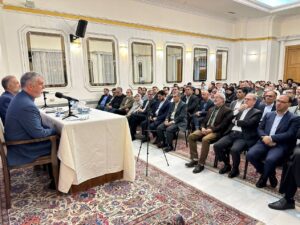
Avash: Masoud Pezeshkian made the remarks on Tuesday evening, September 29, 2026, during a meeting with a group of political and social activists from reformist parties. Thanking the participants for the views and proposals they put forward, he referred to his speech at the United Nations General Assembly and said, “The speech I delivered at the UN General Assembly was the result of the collective wisdom of both reformist and principlist parties. I incorporated the proposals conveyed to me by those present into my own remarks and, based on my convictions and beliefs, firmly spoke about the legitimate rights of the Iranian people.”
Referring to the composition of those attending the meeting and outlining the fundamental strategy of reformism, the president said, “The foundation of reformism is flexibility on one’s own part, not on the part of the other side. Therefore, to the greatest extent possible, we need to increase solidarity, establish coordination and strengthen cohesion among all the political capacities available in the country, because divisions weaken society.”
Pezeshkian urged reformist political activists to play their part and help strengthen a culture of dialogue, saying that on current national issues, particularly negotiations and their course, there should naturally be dialogue with society and the need for negotiations should be defended. “Highlighting the benefits and achievements of negotiations does not mean that we bow to the enemy; rather, it is an expression of transparency,” he said. “An important point in the process of social dialogue is to avoid confrontation, creating divisions and widening social rifts.”
The president described strengthening welfare, promoting solidarity and expanding social cooperation as prerequisites for measures that reformist activists can undertake at the community level. “If we act in a way that causes society to become divided and polarized, we will be moving in the direction sought by the enemy, because the enemy is seeking the social collapse of our country,” he said. He added that understanding how to raise public awareness and persuade society on current political and social issues is a skill that must be developed in accordance with the needs of different audiences.
Elsewhere in his remarks, Pezeshkian referred to the consensus reached at the Supreme National Security Council on holding negotiations and the policies adopted by the council regarding the Islamabad agreement. He said, “The strategy agreed upon at the Supreme National Security Council regarding negotiations demonstrates cooperation and solidarity and is a major achievement. Twelve of the council’s 13 members supported the decision. These were individuals who were knowledgeable about and involved in the issues of war and politics. We will make every effort to finalize the memorandum and will firmly stand up for the rights of the Iranian people.”
“The point under the current circumstances is that the memorandum must now be based on a win-win strategy,” he added. “We seek to restore peace, security and calm to society and the region, while having a clear roadmap and outlook for the continuation of the war and its consequences.”
The president described collective participation as an essential requirement for upholding the dignity of the country, saying, “We must all help ensure that the affairs of the country move forward with dignity. We should state the truth and, through reason and argument, explain the benefits and achievements of the agreement and negotiations. No dignity has been lost in the agreement that was reached. Rather, the United States was bound by obligations that had to be implemented step by step.”
“At no point in the Islamabad memorandum did we retreat from our principles. To the extent possible, we sought to defend the dignity and standing of the Iranian people based on the principles of wisdom, dignity and prudence,” he said.
Pezeshkian also described improving people’s livelihoods as one of the requirements of Islamic governance, saying, “The Quran is a book to be acted upon, and as a Muslim responsible for the future of society, I must work toward the development, dignity and honor of all citizens, regardless of their gender, religion or political affiliation.”
He referred to numerous verses in Quranic chapters, including Al-Fajr, Al-Insan and Al-Ma’un, that emphasize addressing the conditions of all members of society, including the poor, needy, orphans and other vulnerable groups. “From the Quranic perspective, everyone must be treated with justice and fairness,” he said.
The president continued, “Justice is achieved by respecting the rights of members of society. As a Muslim ruler, we have no right to deprive others of their rights or disregard them because of their political or other affiliations. I have no fear of martyrdom in the pursuit of justice and the observance of fairness, because my concern is serving the people. This is the path I have chosen to reduce and resolve their hardships and problems. Along this path, coordination across different sectors, national unity and internal cohesion are essential.”
Referring to other Quranic verses, Pezeshkian said, “One of the prominent characteristics of a Muslim is truthfulness and honesty. We must always speak the truth and follow the straight path. Honoring commitments, keeping one’s word and standing by agreements are among the manifestations of the straight path.”
At the beginning of the meeting, Mohammad Jafar Ghaem-Panah, the president’s executive deputy, presented a report on the damage and strategic shocks caused by the imposed third war, as well as the extraordinary measures taken by the national unity government in various political, economic and social fields, wartime crisis management and efforts to enhance society’s resilience.
The report covered a range of issues, including assessments of damage to maritime, air, rail and road fleets; the development of fuel infrastructure; ensuring the stability of the energy network; healthcare and education; governance and the administration of the country; Iran’s power and standing; and public satisfaction with the government’s tireless efforts, as measured through opinion polls.
Thirteen reformist political activists — including Mohsen Aminzadeh, Mohammad-Hossein Adeli, Lotfollah Meysami, Azar Mansouri, Mohammad Mohajeri, Davoud Heshmati, Hassan Sobhan, Mohammad-Hossein Sharifzadegan, Mohammad-Ali Abtahi, Ahmad Masjed-Jamei, Seyyed Hassan Rasouli, Fayyaz Zaker and Mohammad Javad Zarif — subsequently praised Dr. Pezeshkian’s dignified remarks at the UN General Assembly, describing them as reflecting the culture, history and rich civilization of Iran.
They also voiced support for the president’s firm positions on the Islamabad agreement, saying, “The Islamabad Memorandum of Understanding is a source of pride and a highly effective and decisive document in the history of Iran’s developments.”
In addition, the reformist activists presented multifaceted analyses and raised a number of issues in brief remarks. These included paying attention to people’s livelihoods and improving economic conditions; making smart use of diplomatic tools to halt and end the war; expanding foreign relations and pursuing active diplomacy with neighboring countries; drawing on cultural capacities in engagement with other countries; explaining the achievements of the Islamabad agreement through the media; and closely monitoring future developments in the United States and Israel’s hostile actions.