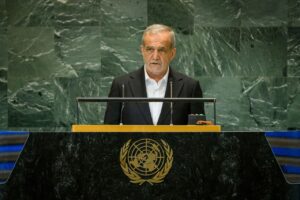
Speaking at the 81st session of the United Nations General Assembly on Wednesday, September 23, 2026, Pezeshkian said that the U.S. president had described Iran as a terrorist state, while Iran itself had been a victim of terrorism.
“I come from an Iran whose leader was assassinated without any legal justification,” he said, referring to the killing of Iran’s leader. “I come from an Iran where a school was bombed. Look at the children of Minab—children who were bombed and killed. Israel and the United States used their weapons to kill our children, who had committed no wrongdoing.”
Pezeshkian said that children, women, scientists and ordinary people had been killed in attacks on Iran.
“Lamerd is a small city in Iran. Our children were exercising in a sports hall when the United States bombed it with cluster bombs that break apart into thousands of fragments,” he said. “They killed our scientists, our people, our women and our children. Those who are terrorists and train terrorists call us terrorists. We only defended ourselves; we are not terrorists.”
The president said Iran had come under attacks using the latest military equipment, but that the Iranian people had defended their country.
“They attacked us, but we did not bow our heads. We responded to their attacks, but we did not attack civilians,” he said, adding that schools, hospitals, scientific centers, bridges and infrastructure had been targeted from territories used to launch attacks, which he described as violations of international law.
Pezeshkian also referred to the assassination of Ismail Haniyeh in Tehran, saying that Israel “bombs and assassinates wherever it wants.” He accused Israel of killing tens of thousands of people in Gaza and carrying out what he called genocide, while accusing others of terrorism.
“They claim that Iran is a source of instability. Are we the source of instability because we want to live independently and refuse to bow our heads?” he asked. “Are those who assassinate, kill and commit crimes the ones responsible for security and peace?”
He stressed that Iran needed sufficient power to defend itself, saying, “A nation that cannot defend itself will be crushed in this world.”
Iran Seeks Power to Defend Itself, Not to Attack Others
Pezeshkian said Iran had not attacked any country in the past 200 years and had always acted in self-defense.
“Today, we are accused of being a source of insecurity in the region,” he said. “This has led us to adopt a strategy based on building the power we need to defend ourselves. We do not seek power to invade others. We need energy for development, not to build bombs, destroy or threaten societies. We want to contribute to security.”
He said the Iranian people had spent the past seven months defending their country against those whom he said had been encouraged and armed by the United States and Israel.
“Our people are our strength, and we have stood with the power of our people,” he said. “Our first principle is power for defense.”
Pezeshkian said Iran should be strong enough to ensure that its survival and progress could not be threatened, while using its power responsibly and not seeking security through insecurity among its neighbors.
Speaking about Iran’s defensive capabilities, he said Iran’s defense systems were designed to ensure that “no one would think bombing Iranian cities would go unanswered.”
“Iran’s military power is for defense, but let me be clear: we do not ask anyone for permission to defend our country.”
Iran Rejects Nuclear Weapons but Insists on Its Right to Nuclear Technology
Pezeshkian said Iran wanted energy for development, arguing that its peaceful nuclear program should be viewed as part of the country’s right to development.
“Nuclear energy means treatment for patients, food security for agriculture, technology for industry and reliable electricity for the future,” he said.
“Iran will not accept nuclear knowledge becoming the exclusive privilege of a handful of countries. Iran does not regard nuclear weapons as a source of security, but it will not give up its right to science, industry and peaceful energy. Let me be clear: no nuclear weapons, but no deprivation of nuclear knowledge either.”
He said Iran’s nuclear issue could not be resolved on the battlefield and that the solution was an agreement that would provide the international community with credible assurances about the peaceful nature of Iran’s nuclear program while guaranteeing the Iranian people’s rights.
Iran Does Not Regard Its Neighbors’ Security as a Rival to Its Own
Pezeshkian said Iran’s third principle was “participation for security,” arguing that wars do not respect borders and that crises in one country spill over into neighboring states.
“That is why Iran does not regard the security of its neighbors as a rival to its own security. We want our neighbors to be strong,” he said.
On the Strait of Hormuz, he said it was unacceptable for all countries to benefit from the waterway while Iran, which he described as its historic guardian, was denied access and freedom of navigation even in its own waters under what he called unjust sanctions.
“They close the route to us while weapons, explosives, missiles and energy are transported through the same waterway to destroy countries. This is unacceptable, and we will not allow it to happen again,” he said.
Pezeshkian added that the permanent deployment of hostile fleets and the expansion of war could not create security, arguing that maritime security could not be separated from the security of coastal states.
“We Do Not Fear War in Self-Defense, and We Do Not Shy Away from Negotiations for Peace”
Pezeshkian said regional issues should be addressed by the countries of the region rather than becoming a pretext for distant powers to wage war.
“Strategic independence means that relations with any foreign power must never become a means of enabling war against a neighbor,” he said.
Addressing those he said were responsible for planning and carrying out attacks on Iran, Pezeshkian said Iran had demonstrated its resilience and could not be forced into submission through war.
“Iran has never been the initiator of any war and has always demonstrated its commitment to the negotiating table,” he said. “War was imposed on us, but we proved that we do not fear war when defending ourselves, and we do not shy away from negotiations for peace.”
“There Are Nuclear Bombs in Israel, but Inspectors Are in Iran”
Pezeshkian said rebuilding trust—the stated theme of the UN session—required an end to double standards.
“Nuclear bombs and other weapons of mass destruction in this region are in the hands of the Israeli regime, yet inspections are demanded of Iran,” he said.
“Israel has killed 70,000 people in Gaza, while Iran was bombed at the negotiating table. Israel has nuclear weapons, is not a member of the NPT and has never allowed an inspector into the occupied territories, yet it receives billions of dollars in weapons and enjoys immunity to bomb any capital it chooses.”
“I repeat: there are nuclear bombs in Israel, but inspectors are in Iran. Israel kills, while Iran is sanctioned,” Pezeshkian said, adding that sanctions ultimately harm poor and innocent people.
Iran Calls for an International Order Based on Equality
Pezeshkian said Iran did not seek special privileges but equal rights and responsibilities.
“If international law is enforced only when it serves the interests of the powerful, more countries will conclude that they must rely solely on their own power for security,” he said. “That would mark the beginning of a more dangerous world for all of us.”
He called for avoiding a return to “the politics of force,” saying military power should not replace legitimacy, sanctions should not replace diplomacy, assassinations should not replace politics, and war should not replace dialogue.
“Iran will maintain its power. We call on the world not toward another war, but toward peace and justice—not out of weakness, but out of confidence in our own strength,” he said.
“We Are Ready for Dialogue, but We Will Not Accept the Language of Force”
Pezeshkian said Iran envisioned a future in which security, justice and human dignity were universal and inalienable rights for all nations.
He said a truly international order should be based on equality among nations, justice, fairness and the shared will of humanity.
“Peace that does not include everyone is not peace, and justice that does not apply to everyone is not justice,” he said.
Pezeshkian also criticized remarks made by the U.S. president the previous day, describing them as contrary to the UN Charter and saying threats would only strengthen Iran’s unity and resistance.
“We are ready for dialogue, but let them know that we will not accept the language of force,” he said.