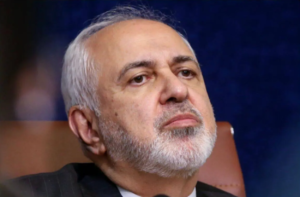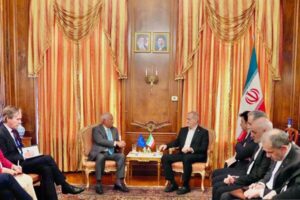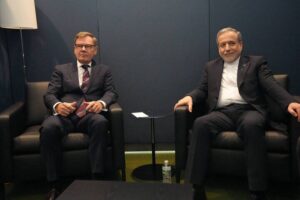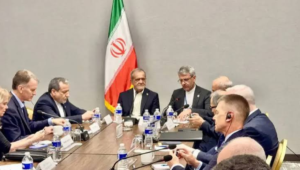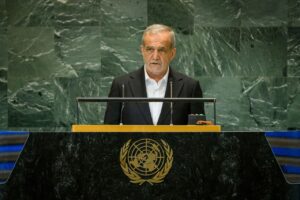
Avash News- Pezeshkian, who has traveled to New York to attend the 81st session of the United Nations General Assembly, made the remarks in an interview with Fox News on the sidelines of the event.
Asked whether Iran chooses war or an agreement, Pezeshkian said: “We did not choose war. War was imposed on us. We are not seeking war. Rather, whenever we are attacked, we are forced to defend ourselves. We have never started a war. But if they want to continue the war against us, we will respond firmly and decisively.”
Pezeshkian added: “Today, the pressures they continuously impose on us are aimed at forcing us to surrender outside the legal framework of international law, which is impossible.”
Asked what Iran would be willing to offer in the course of reaching an agreement, Pezeshkian referred to Iran’s adherence to the Islamabad Memorandum of Understanding aimed at ending the war, saying: “We have no problem. We reached an agreement with your president, and it was signed. That agreement was signed, and on that basis, we are willing and still want to move forward.”
Referring to what he described as U.S. acts of aggression as the source of the current situation regarding maritime traffic in the Strait of Hormuz, the president said: “We had not closed the Strait of Hormuz; it was open. They attacked us without any justification or legal framework. They assassinated and martyred our Supreme Leader, our scientists, our military commanders and government officials.”
Asked about the actions of Yemen’s Ansarullah in resisting the Saudi-led blockade and forces affiliated with Yemen’s former government backed by Riyadh, Pezeshkian said: “Ansarullah is responsible for its own actions. They do not take orders from us. We are in contact with them as a group that is resisting in the region based on the circumstances imposed on them. There is no systematic relationship.”
Elsewhere in the interview, Pezeshkian addressed Iran’s frozen assets abroad, including in China, Iran’s largest oil customer, saying: “One of the problems we face is that our money is blocked in China. You previously referred to allegations that we provide financial assistance to certain people. We cannot even take our own money out of a country to which we have supplied goods, let alone use those funds to pay someone else somewhere else in the world.”
Asked by the interviewer whether protesters in Iran would be executed if they took to the streets, the Iranian president referred to the events of January 2026, which U.S. President Donald Trump has cited as a pretext for interference in Iran’s internal affairs, saying: “Anyone who wants to protest has every right to do so. We sat down and spoke with many of these protesters. Our duty is to be accountable to the people. Protesting is a right, but not with weapons.”
He added: “Trump kept saying, ‘I want to bring a gift to the Iranian people,’ but the gift they brought us was guided missiles, heavy weapons and destruction. What they really want to do is create circumstances inside the country that pave the way for the collapse of the system, society and government.”
Asked about the impact of the U.S. midterm elections on negotiations to end the war and reach an agreement, Pezeshkian said: “If the current U.S. administration wants to reach an agreement within the framework of international law, that is good. In any case, before or after the election, what difference does it make to us?”
He reiterated that Iran has never been the party to initiate a war and said Tehran welcomes dialogue: “We have never sought war. We are not seeking war. I deeply believe that human beings should not cause the death of another human being. We are supposed to be the chosen creatures of creation. When we can resolve issues through dialogue, we should not resort to killing one another.”
Pezeshkian added: “With the provocations carried out by Israel, they imposed this war on us. But we do not want it to continue. It is the United States that must decide whether it wants to bring this to an end.”
Emphasizing the determination of the Iranian government and people to stand against U.S. coercive policies despite the difficulties, the president said: “We will resist until the very last moment. Yes, we have economic problems, but we will endure and withstand every hardship.”
Under the Islamabad Memorandum of Understanding, talks on Iran’s nuclear program were supposed to take place within a 60-day period after the document came into effect. However, the opportunity expired as a result of what Tehran described as the U.S. failure to fulfill its commitments, including its failure to adhere to arrangements concerning maritime traffic through the Strait of Hormuz stipulated in the memorandum, as well as repeated attacks on Iran that also resulted in the deaths of civilians.
Tehran had previously accepted some of the International Atomic Energy Agency’s most stringent monitoring and verification measures for its nuclear program under the nuclear agreement and the lifting of international sanctions. Iran has repeatedly stressed that it will not relinquish its right to a peaceful nuclear program as a member of the Non-Proliferation Treaty (NPT). At the same time, Tehran has said it is prepared to negotiate an agreement that would establish international oversight of its nuclear program in exchange for the implementation of agreed conditions and the lifting of sanctions.